145 posters, 12 topics, 25 sessions, 145 authors
ePostersLive by SciGen Technologies S.A. All rights reserved.
UCSF 2023 Inquiry Symposium
10 May | University of San Francisco

P016
Adverse childhood experiences and binge-eating disorder in early adolescence
Poster Presenter
Authors
Part of Topic
Epidemiology & Population Sciences
Objective: The objective of this study was to examine the associations between adverse childhood
experiences (ACEs) and binge-eating disorder (BED) in a large, national cohort of 9-14-year-old early
adolescents in the US. The study also sought to determine which types of ACEs (i.e. abuse, neglect,
household challenges) were most strongly associated with BED.
Background: ACEs are common and linked to negative health outcomes, including eating disorders.
BED, the most common eating disorder, is characterized by frequent episodes of food consumption and
loss of control associated with shame and distress during episodes. Previous studies have found
associations between ACEs and BED, though they have mainly focused on adults and use cross-
sectional data. Thus, there is a paucity of studies investigating the associations between ACEs and BED
in early adolescence using large, national samples.
Methods: We analyzed prospective cohort data from the Adolescent Brain Cognitive Development
(ABCD) Study (N = 10,145, 2016-2020, ages 9-14). Logistic regression analyses were used to determine
the associations between self-reported ACEs and BED based on the Kiddie Schedule for Affective
Disorders and Schizophrenia at two-year follow-up, adjusting for sex, race/ethnicity, baseline household
income, parental education, site, and baseline binge-eating disorder.
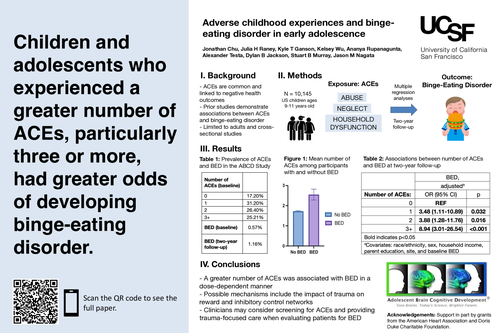
Results: In the sample, (49% female, 46% racial/ethnic minority), 82.8% of adolescents reported at least
one ACE and 1.2% had a diagnosis of BED at two-year follow-up. The mean number of ACEs was
higher in those with a diagnosis of BED compared to those without (2.6 ± 0.14 vs 1.7 ± 0.02). The
association between number of ACEs and BED in general had a dose-response relationship. One ACE
(adjusted odds ratio [aOR] 3.48, 95% confidence interval [CI] 1.11-10.89), two ACEs (aOR 3.88, 95%
CI 1.28-11.74), and three or more ACEs (aOR 8.94, 95% CI 3.01-26.54) were all associated with higher
odds of BED at two-year follow-up. When stratified by types of ACEs, history of household mental
illness (aOR 2.18, 95% 1.31-3.63), household violence (aOR 2.43, 95% CI 1.42-4.15), and criminal
household member (aOR 2.14, 95% CI 1.23-3.73) were most associated with BED at two-year follow-
up.
Conclusions: Children and adolescents who have experienced ACEs, particularly household challenges,
have higher odds of developing BED. Clinicians may consider screening for ACEs and providing
trauma-focused care when evaluating patients for BED.