145 posters, 12 topics, 25 sessions, 145 authors
ePostersLive by SciGen Technologies S.A. All rights reserved.
UCSF 2023 Inquiry Symposium
10 May | University of San Francisco

P080
Disparities and trends in the management of acute and degenerative meniscus tears: Ten years in review
Poster Presenter
Authors
Part of Topic
Clinical & Translational Sciences
Introduction: Meniscus tears are a common knee pathology that can be treated non-surgically
or with surgical management, most commonly with arthroscopic partial meniscectomy or
meniscus repair. There is evidence that patients can achieve equal outcomes with surgical or
non-surgical management, however, many patients continue to opt for surgical treatment.
Physicians often recommend non-surgical treatments first unless patients’ tear type or
symptoms warrant expedient surgery, however, it is unclear whether there are differences in
the likelihood of surgical intervention based on patient characteristics and whether there are
differences in the non-operative treatments utilized by patients who are treated with or
without surgery. Understanding the trends and disparities in treatment strategies including
surgical approach and non-operative treatments utilized is important to best counsel patients.
Hypothesis: We hypothesize that older patients, patients with a higher body mass index,
patients with Medicare insurance, and patients with chronic or degenerative tear types will be
less likely to undergo surgery and that most patients will trial physical therapy and non-
steroidal anti-inflammatory medications. We hypothesize that there will be increasing
utilization of surgical management over time, and that the relative proportion of patients who
undergo repair versus partial meniscectomy will increase.
Aims: The goals of this study are to evaluate trends and disparities in the management of
meniscus tears over the last ten years according to patient characteristics and diagnosis codes.
We also seek to understand the relative utilization of different non-operative and operative
treatments, including the proportion of patients undergoing partial meniscectomy versus
meniscus repair. The data analyzed for this project will ultimately be used to generate a model
that can predict the ultimate treatment strategy for patients presenting with a meniscus tear.
Project Design: This is a retrospective observational cohort study. Data was obtained from the
UCSF de-identified patient database. All patients over the age of 18 evaluated at UCSF for a
diagnosis of meniscus tear from January 1st , 2010 to December 31st , 2019 were included.
Exclusion criteria included a combined diagnosis of meniscus tear and cruciate ligament injury
and lack of medication information. I collaborated with Carolina Ramirez, an imaging data
scientist, to extract data including patient demographic information, encounter data, non-
operative treatment data including medications, physical therapy referrals, and steroid
injections, and surgical data. Analysis was limited to medications and physical therapy
prescribed outside of the perioperative period, defined as 14 days before surgery onwards.
Statistical analysis was performed to assess for trends in treatment modality using STATA 16.1.
Statistical significance was defined as p<0.05.
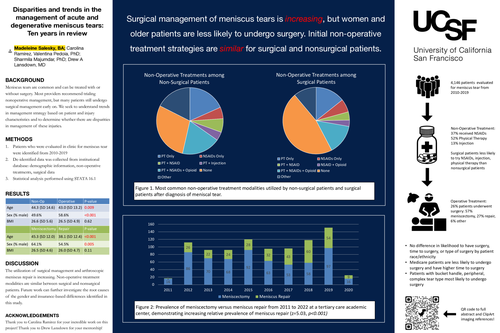
Results: A total of 4,146 patients were included for analysis, including 1,088 patients (26%)
treated surgically and 3,058 patients (74%) treated non-surgically. There was increasing
prevalence of surgical management over time (p<0.001) and increasing prevalence of meniscus
repair versus meniscectomy among patients who had surgery (p<0.001). Bucket-handle,
complex, and peripheral tears were most likely to be managed surgically. There was no
difference in the likelihood of surgery (p=0.66), time to surgery (p=0.87) or type of surgery
(p=0.49) by patient race or ethnicity. Men were more likely to have surgery (p<0.001), but
women were more likely to undergo repair (p=0.005). Patients with Medicare insurance were
less likely to undergo surgery (p<0.001) and had significantly increased time to surgery
(p=0.003). Overall, non-surgical patients were more likely to trial non-operative treatments
including NSAIDs and physical therapy and to undergo steroid injection (p<0.001, respectively).
Among surgical patients, meniscectomy patients were more likely to trial injection and physical
therapy before surgery (p<0.001, p<0.001).
Discussion: This project identified several trends in the management of meniscus tears.
Specifically, we demonstrated that the surgical management of meniscus tears is increasing,
and that meniscus repair is being increasingly utilized. We did not identify differences in
treatment strategy based on patient race or ethnicity, which was expected. We did identify that
male sex and decreased age were associated with increased likelihood of surgical management,
which was expected. Although surgical management was less common among MediCare
patients, we identified that MediCare patients who do undergo surgery have significantly
longer time from initial diagnosis to surgery. Interestingly, time to surgery was not associated
with age, so this disparity is likely due to other factors such as insurance approval difficulties,
increased openness to non-operative treatment modalities, or reduced activity demands in this
population. Additional research is necessary to identify the root cause of this observation. We
also determined that patients who did not undergo surgery were more likely to be prescribed
NSAIDs, physical therapy, and steroid injections compared to patients who did undergo surgery.
This may suggest that increased early non-operative intervention could reduce the need for
surgical management in the future. Finally, we identified that certain diagnosis qualifiers are
associated with different treatment strategies. Database limitations included lack of patient
reported outcomes and lack of ability to combine Epic data with notes data or imaging data.
Our sample was also limited to a single center, which reduces the generalizability of our
findings. Future research can build off these results to incorporate more detailed imaging
findings to specifically tailor treatment recommendations to patients’ unique anatomy.
Imaging References for Poster:
Group of people icon – Stock Photography Clip Art PNG. Favpng.com. (n.d.). Retrieved
February 18, 2023, from https://favpng.com/png_view/group-of-people-icon-stock-
photography-clip-art-png/vLT6xBkz
Medicine pills clipart: Full size png download. Creazilla.com. (n.d.). Retrieved February 18,
2023, from https://creazilla.com/nodes/61038-medicine-pills-clipart
Surgery clipart black and white: Full size png download. SeekPNG.com. (n.d.). Retrieved
February 18, 2023, from https://www.seekpng.com/ima/u2w7i1q8q8e6w7o0/