145 posters, 12 topics, 25 sessions, 145 authors
ePostersLive by SciGen Technologies S.A. All rights reserved.
UCSF 2023 Inquiry Symposium
10 May | University of San Francisco

P079
Implementation of a Pre-Intubation Airway Checklist in the Emergency Department: A retrospective study looking at peri-intubation complications
Poster Presenter
Authors
Part of Topic
Clinical & Translational Sciences
Title: Implementation of a Multi-Disciplinary, Pre-Intubation Airway Checklist at a Level 1
Trauma Center
Authors: Matthew Roces, René Monzon, Michaela Gonzalez, Ryan Lichtarge, John-Lloyd Kevin
Santamarina, Reginald Nguyen, Tianyu Tang, Newton Addo, Justin Teng, Elizabeth Liu, Katrina Jean
Gabriel-Ramos, Kayla Enriquez, Joseph Brown
Background
Endotracheal intubation (ETI) is a vital, high-risk procedure for resuscitating critically ill patients.
Standardized pre-intubation checklists have been shown to enhance interdisciplinary
communication and reduce adverse effects. The SOLID Plan (Summarize, Optimize, Location,
Identify, Drugs, and backup Plan) was implemented in a level 1 trauma center with aims to
improve first pass success and reduce complication rates.
Study Design/Methods
The SOLID Plan was implemented in January 2021. A retrospective chart review of all patients
requiring ETI in the Emergency Department (ED) from January 2020- December 2021 was
conducted. Multiple variables and outcomes were evaluated pre and post checklist
implementation, including training level of intubating physician, first pass success, and
complications. Data were analyzed using chi-square or fisher’s exact test. Odds of first past
success were assessed with logistic regression.
Results/Findings
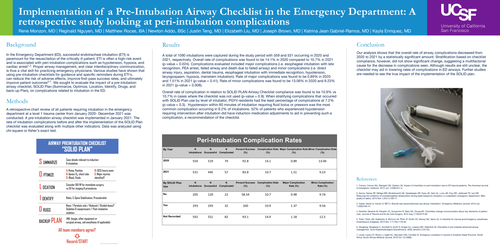
1090 intubations were analyzed with 559 and 531 occurring in 2020 and 2021, respectively.
Overall rate of complications (hypotension, hypoxia and PEA arrest) was found to be 14.1% in
2020 compared to 10.7% in 2021 (p=0.024). There was no statistically significant difference in
complication rate in 2021 in relation to checklist compliance. First pass success rate in 2021 was
found to be 88% with SOLID plan use vs 85% when not used. There was no statistically
significant difference in first pass success rate comparing 2021 vs 2020 (p=0.16) when adjusted
by intubator. Lastly, all intubator levels were found to have no difference in complication rate
nor odds of first pass success when there was a documented use of the SOLID Plan [AOR (95%
CI) = 1.17 (0.69 - 1.96)].
Conclusion
Our study did not find an improvement in complication or first pass success rates, although no
data was found to be statistically significant. These results suggest multifactorial causes for the
occurrence of peri-intubation complications and first pass success. This study was conducted
during the height of the COVID-19 pandemic which could have had an unmeasured but
significant impact including more difficult airways and delays in intubation. Additionally, the
“most senior operator” often managed airways, which might have dampened the checklist's
effect on junior operators. Further factors need to be explored in conjunction with the
implementation of a checklist.