145 posters, 12 topics, 25 sessions, 145 authors
ePostersLive by SciGen Technologies S.A. All rights reserved.
UCSF 2023 Inquiry Symposium
10 May | University of San Francisco

P078
Identification of Cardiac Risk Factors in High-Risk Pregnancies
Poster Presenter
Authors
Part of Topic
Clinical & Translational Sciences
Title: Identification of Cardiac Risk Factors in High-Risk Pregnancies
Introduction:
High-risk pregnancies are pervasive in California’s Central Valley. At Community Regional
Medical Center (CRMC), several recent major cardiovascular complications in pregnant patients
with no known prior heart disease have prompted a multidisciplinary approach to establish a
screening tool for cardiovascular disease in pregnancy. The 2017 California Maternal Quality
Care Collaborative (CMQCC) toolkit was created by the state of California to help stratify
symptomatic or high-risk pregnant or postpartum women and determine initial cardiac work
up. Pregnancy induces physiological changes that stresses the cardiovascular system. The
challenge in creating a functional screening tool for this patient population is the overlap
between symptoms of normal pregnancy and heart disease including, but not limited to, lower
extremity edema, tachycardia, shortness of breath, and fatigue.
Clinical Question:
Can retrospective application of the 2017 CMQCC screening tool for cardiovascular disease in
addition to collection of different variables allow modification to improve specificity?
Aims:
Identify high-risk pregnant patients for cardiovascular disease who should receive an early
cardiology consultation.
Project Design/Methods:
This is a retrospective chart review of all pregnant patients admitted by CRMC’s Department of
Obstetrics and Gynecology from April 2017 to April 2019. The inclusion criteria are patients
(n=442) admitted for pregnancy-related reasons (planned delivery, high-risk pregnancy, etc.)
who have had one or more of the following: electrocardiogram, chest x-ray, echocardiogram,
natriuretic peptide, or troponin level. Subject ID numbness will be given to identify patients for
data analysis; thus, the anticipated risk of the study is considered minimal. We plan to utilize
Statistical Package for the Social Sciences (SPSS) to perform comparative analysis and modify
the CMQCC toolkit to increase its specificity.
Results:
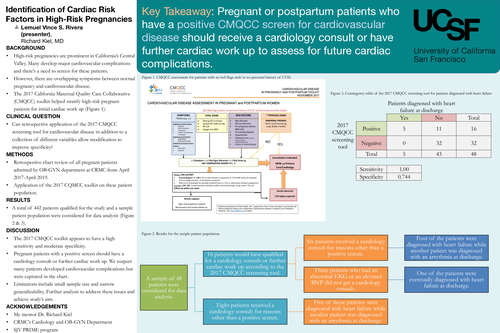
A sample of 48 patients were considered for data analysis. According to the 2017 CMQCC
screening tool, 33% (n=16) of these patients should have received a cardiology consult or
should have an EKG or BNP ordered for further work up. Only 37.5% (6/16) of these patients
attained a cardiology consult for reasons other than a positive screen. Additionally, three of the
patients who had a positive screen and either had an abnormal EKG or elevated BNP did not
have a consult for cardiology. For pregnant patients who were diagnosed with cardiomyopathy
at discharge, the 2017 CMQCC toolkit showed a 100% sensitivity and 74.4% specificity.
Conclusion:
From our limited data analysis, we determined that the 2017 CMQCC toolkit has a high
sensitivity and moderate specificity for cardiovascular outcomes. Pregnant patients with a
positive screen should receive a cardiology consult or have further cardiac work up. We suspect
that many of these patients may have developed worsened cardiovascular complications that
was not fully captured in the chart. Limitations of our study includes a small sample size and a
select patient population from a region known for high-risk pregnancies that may limit
generalizability. Further analysis is needed to modify the 2017 CMQCC screening tool to
improve specificity.