145 posters, 12 topics, 25 sessions, 145 authors
ePostersLive by SciGen Technologies S.A. All rights reserved.
UCSF 2023 Inquiry Symposium
10 May | University of San Francisco

P075
Strategies to close the PrEP uptake gap among men who have sex with men and transgender people in Gauteng, South Africa: perspectives from the community
Poster Presenter
Authors
Part of Topic
Clinical & Translational Sciences
Introduction: In the backdrop of high HIV vulnerability among sexual and gender minorities in South Africa, there remains slow uptake of daily oral HIV pre-exposure prophylaxis (PrEP) despite South Africa being the first African country to approve PrEP. This mixed-methods study aimed to explore facilitators and barriers to daily oral PrEP uptake to identify strategies to increase utilization in these key populations.
Research questions: What is the utilization rate of daily oral PrEP among MSM and TG adults in Gauteng, South Africa? What factors are associated daily oral PrEP willingness and utilization in this study population?
Aims: Aim 1: Evaluate the rates of daily oral PrEP awareness and acceptance in our study population. Aim 2: Quantify daily oral PrEP utilization rates. Aim 3: Characterize barriers and facilitators to daily oral PrEP willingness and uptake.
Methods: A cross-sectional survey was administered to men who have sex with men (MSM) and transgender (TG) adults residing in Soshanguve, Gauteng; followed by in-depth interviews. Participants were recruited by a team of trained community outreach workers at local community organizations, LGBTQ service programs, and snowball sampling. The survey and interview guide captured daily oral PrEP utilization, preferences, and attitudes The survey elicited information on sociodemographics and daily oral PrEP awareness, acceptability, attitudes, and use. Quantitative analysis of survey data was performed in STATA13 using descriptive statistics and univariate logistic regression; thematic analysis was performed for qualitative data.
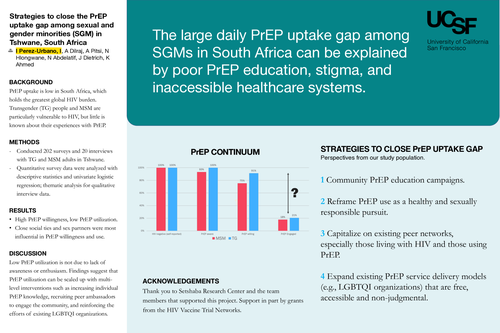
Results: We conducted 202 cross-sectional surveys and 20 in-depth interviews between July 2021 and June 2022. A large majority of survey participants were PrEP aware (95%) and willing to use it (83%), but only 15% had ever used PrEP in their lifetime. Interview participants reported a lack of community knowledge about PrEP, accompanied by discouraging messaging that associated PrEP with promiscuity, HIV stigma, and lack of safety for HIV-negative individuals. Close social ties (i.e., sexual partners, friends, family) played a crucial role in encouraging PrEP use and disseminating reliable information about it, particularly those who were PrEP-engaged and HIV-positive sexual partners. Among our survey participants, receiving information about HIV from friends and family was associated with willingness to use daily oral PrEP (odds ratio = 2.50, 95% CI = 1.04, 5.97, p-value < 0.05), India Perez-Urbano having more than one close social tie on PrEP was associated with PrEP engagement (odds ratio = 2.71, 95% CI = 1.05, 6.99, p-value < 0.05), particularly a sexual partner (p = 0.027). In addition, participants recognized local LGBTQI organizations as models of inclusive, efficient, and accessible PrEP service delivery, when compared to public and private healthcare facilities.
Discussion/Conclusion: Despite high willingness to use PrEP, utilization rates are low among MSM and transgender people. This can be explained by lack of knowledge, stigmatizing community perceptions, and poorly accessible PrEP service models within South African communities. Drawing from the insights provided by our participants, we outlined four strategies to facilitate PrEP utilization in this demographic: (1) robust community-engaged PrEP education; (2) reframe PrEP use as a sexually responsible pursuit; (3) capitalize on peer networks; and (4) expand accessible and de-stigmatizing PrEP service models. Our findings contributes valuable recommendations for the ongoing pursuit to understand the unique needs and preferences of sexual and gender minorities, as it relates to PrEP.