145 posters, 12 topics, 25 sessions, 145 authors
ePostersLive by SciGen Technologies S.A. All rights reserved.
UCSF 2023 Inquiry Symposium
10 May | University of San Francisco

P072
Opposing Patterns of Psychiatric Disease in Behavioral Variant Frontotemporal Dementia and Early Onset Alzheimer's Disease
Poster Presenter
Authors
Part of Topic
Epidemiology & Population Sciences
Introduction:
Early onset dementias represent diagnostic challenges. Frontotemporal dementia (FTD) is second only to
Alzheimer Disease (AD) among neurodegenerative causes of dementia in those with onset ≤ 65 years.
Among FTD, behavioral variant FTD (bvFTD) is the most common subtype. There is considerable
phenotypic overlap between bvFTD and various psychiatric disorders. Additionally, up to 50% of patients
with bvFTD have prior history of at least one primary psychiatric diagnosis. Despite this, the associations
between psychiatric burden and bvFTD remain relatively understudied, especially compared to other
dementias such as AD.
Hypothesis or question:
What is the prevalence of psychiatric disorders in bvFTD and EOAD, and how do they compare to each
other and the general population?
Aims:
Characterize psychiatric comorbidity in two early-onset dementia syndromes to guide future research
questions
Project Design/Methods:
We screened 334 bvFTD patients from the University of California San Francisco (UCSF)
Memory and Aging Center (MAC) between 1998-2021 for the prevalence of psychiatric
conditions (depression (DPN), anxiety (ANX), post-traumatic stress disorder (PTSD), obsessive
compulsive symptoms (OCS), hoarding behavior (HOARD), bipolar disorder (BPD), schizophrenia
SCZ, and psychosis not otherwise specified (PSYCH) and compared the rates of psychiatric
disease history to a group of 555 early onset AD (EOAD) participants also from the UCSF MAC
between 1998-2016.
Results/Product:
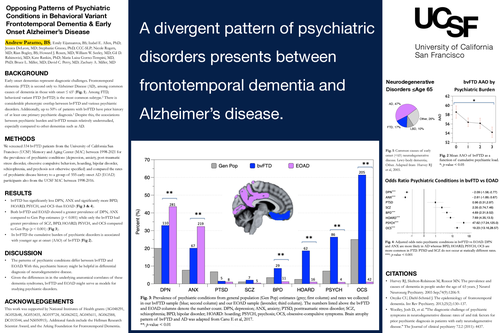
bvFTD has significantly less DPN, ANX and significantly more BPD, HOARD, PSYCH, and OCS than EOAD.
Both bvFTD and EOAD showed a greater prevalence of DPN and ANX compared to general population
estimates (p < 0.001) while only the bvFTD had greater prevalence of SCZ, BPD, HOARD, PSYCH, and OCS
compared to general population estimates (p < 0.001). In bvFTD the cumulative burden of psychiatric
disorders is negatively associated with age at onset (AAO) of bvFTD.
Discussion/Conclusion:
The patterns of psychiatric conditions differ between bvFTD and EOAD. With this, psychiatric
history might be helpful in the differential diagnosis of neurodegenerative disease. These
differences might reflect underlying anatomical correlates in the studied psychiatric disorders,
serving as a model for studying psychiatric disorders. The inverse relationship between
cumulative psychiatric burden and bvFTD AAO was a curious finding from which no conclusions
can be drawn at this time; a literature search reveals multiple working hypothesis such as a
causative relationship (unidirectional vs bidirectional) and shared neuroanatomical
vulnerabilities among others. Next steps include the characterization of psychiatric burden in
other FTD clinical syndromes and assessing their differential prevalence among patients with
known neuropathology and genetic mutations.