145 posters, 12 topics, 25 sessions, 145 authors
ePostersLive by SciGen Technologies S.A. All rights reserved.
UCSF 2023 Inquiry Symposium
10 May | University of San Francisco

P071
Bone Bruise Patterns Associated with Pediatric and Adult ACL Tears are Different
Poster Presenter
Authors
Part of Topic
Clinical & Translational Sciences
Introduction: ACL tears are one of the most common ligament injuries in the United States. The
annual incidence of ACL tears in the United States is 68.6 per 100,000 person-years resulting in
about 100,000-200,000 ACL reconstructions a year and costing approximately 1.7 billion dollars
annually. While many imaging studies have been conducted to identify common radiographic
indicators of ACL injury, there is limited data regarding the relative proportions of associated
imaging findings among adult and pediatric patients with primary ACL tears.
Hypothesis: We hypothesized that differences in imaging patterns would exist between pediatric
and adult patients with primary ACL tears. These patterns may be related to differences in
patient biomechanics or mechanism of injury.
Aims: The purpose of this paper is to describe differences in x-ray and magnetic resonance
imaging (MRI) findings between adult and pediatric patients with known primary ACL injuries.
This may aid the diagnostic evaluation and surgical planning for treatment of these injuries.
Methods: We performed a retrospective analysis of surgical patients at our institution with a
history of primary anterior cruciate ligament tears over a six-year period. Patients were divided
into two cohorts based on age (age ≤15 years old or age ≥21 years old). Patient x-rays and MRI
studies were used to compare features between the two groups including fracture incidence, bone
bruising pattern, associated ligamentous injuries, and meniscal injuries. Proportions of associated
findings were analyzed using the two proportions z-test.
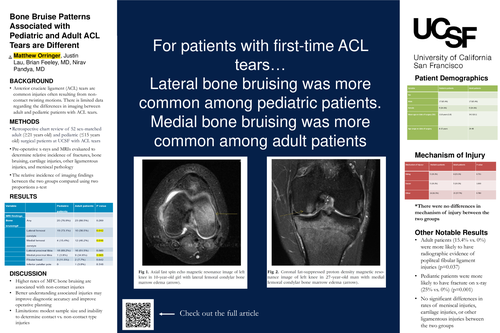
Results: Among our cohort of 52 sex-matched pediatric and adult patients, we found that
pediatric patients were more likely to have x-ray evidence of fracture (p=0.001) and MRI
evidence of lateral femoral condyle bone bruise (p=0.012). Adult patients had higher rates of
medial femoral condyle (p=0.016) and medial proximal tibial bruising (p=0.005) as well as
popliteal fibular ligament injuries (p=0.037) identified on MRI.
Discussion/Conclusion: In this study, we identified differences in bone bruise patterns between
pediatric and adult patients with primary ACL tears. Pediatric patients were more likely to have
x-ray evidence of fracture and MRI evidence of LFC bone bruising. Adult patients were more
likely to demonstrate MFC and medial proximal tibia bone bruising as well as popliteal fibular
ligament injury. Prior research has shown that LFC bruising patterns are more common among
pediatric and adult patients with primary ACL tears. However, MFC bruising patterns are
especially common among those with non-contact injuries. As such, it is possible that our adult
patient cohort had disproportionately high rates of non-contact injuries. Our project successfully
identified differences in bone bruising patterns between pediatric and adult patients with primary
ACL tears that may guide diagnostic workup and preoperative planning in the future. However,
there are limitations to our study design including the modest sample size, the potential for
differences in evaluation of radiographic imaging studies, and the inability to obtain more
granular information in the chart review process regarding mechanism of injury of these patients.
Future research may address the association between patient age and contact vs. non-contact
mechanism of ACL injury and the biomechanics that lead to concomitant PFL injuries with ACL
tears.