145 posters, 12 topics, 25 sessions, 145 authors
ePostersLive by SciGen Technologies S.A. All rights reserved.
UCSF 2023 Inquiry Symposium
10 May | University of San Francisco

P069
Hyponatremia Following Embolotherapy for Well-Differentiated Neuroendocrine Tumor Metastases
Poster Presenter
Authors
Part of Topic
Clinical & Translational Sciences
Introduction:
Palliative embolotherapies for well-differentiated neuroendocrine tumor liver metastases
(WD-NETLM) include transcatheter arterial chemoembolization (TACE) and transcatheter arterial
embolization (TAE). TACE and TAE have similar efficacy and low rates of complications. Case
reports have described hyponatremia occurring after embolotherapy, but no larger scale studies have
been documented.
Aims:
Describe the incidence of and consider predictive factors for developing hyponatremia after hepatic
TACE and TAE for WD-NETLM.
Project Design/ Methods:
We retrospectively collected data for all outpatient TACE and TAE procedures performed at our
institution for patients with NETLM between January 2012 and July 2022. Concurrent
antihypertensive, diuretic, antiemetic, opiate medication, and intravenous fluid use within 24 hours of
the procedures were noted. Univariate and multivariate logistic regression analyses were performed
to determine significant predictors of severe (Grade ≥ 2) hyponatremia. Markov correlation structure
for repeated measurements was applied. P-values <0.05 were considered significant.
Results/ Product:
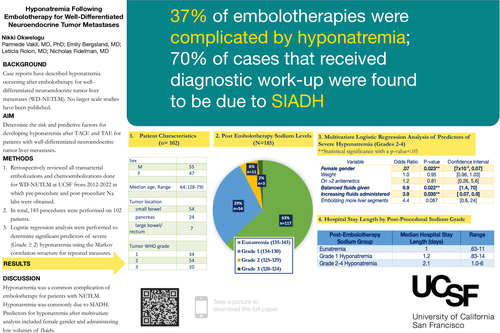
A total of 102 patients (54% men; median age 64 years, range 28 to 79) who underwent 185
procedures were included. The small bowel was the most common primary tumor site (n=54)
followed by pancreas (n=24). Tumors were WHO grade 1, 2, and 3 for 34, 54, and 10 patients,
respectively. Of 185 procedures, 69 (37%) were complicated by post-procedure hyponatremia (54
Grade 1, 11 Grade 2, 3 Grade 3, and 1 Grade 4). The median time to sodium nadir was 1 day. Ten of
twelve patients with Grade 2-4 hyponatremia (Na<130) received a medical work-up, and seven of
them were diagnosed with syndrome of inappropriate antidiuretic hormone secretion (SIADH). All
patients with hyponatremia were asymptomatic and none required admission to intensive care due to
hyponatremia. The average length of hospital stay for patients with post-procedure eunatremia was 1
day, compared to 1.2 days for grade 1 hyponatremia (p= 0.98), and 2.1 days for grade 2-4
hyponatremia (p=0.22). Grade 2-4 hyponatremia was associated with female gender (p=.023) and
higher volumes of fluids administered (p=.035).
Discussion/Conclusion:
Hyponatremia was a common complication of embolotherapy for patients with NETLM and was
mostly due to SIADH. Hyponatremia did not significantly prolong hospital stays. Predictors for
hyponatremia after multivariate analysis included female gender and administering low volumes of
fluids. However, balanced fluids including lactated ringers and plasmalyte may be protective. More
investigation is needed to better understand the relationship between fluid use and hyponatremia