145 posters, 12 topics, 25 sessions, 145 authors
ePostersLive by SciGen Technologies S.A. All rights reserved.
UCSF 2023 Inquiry Symposium
10 May | University of San Francisco

P064
Trends in the Management of Femur Fractures in Young Children
Poster Presenter
Authors
Part of Topic
Clinical & Translational Sciences
Introduction: Femoral shaft fractures in young children are commonly treated with closed reduction and spica casting; however, there is increasing literature and interest focusing on internal fixation. To our knowledge, there are no studies assessing current trends in the management of this injury.
Hypothesis/Question: How has the management of femur fractures in young children changed over time, and does treatment modality differ by demographic factors, including age. We hypothesize that there is growing popularity in the utilization of internal fixation/plate osteosythnesis and other modalities beyond the traditional spica casting
Aims: This study aims to assess trends in the management of femoral shaft fractures in patients under the age of 6.
Methods: This is a retrospective study utilizing a large pediatric database. The Pediatric Health Information System (PHIS) database was queried for patients aged 1 to 6 years who had an isolated, closed femoral shaft fracture from October 2015 to December 2020. ICD10 procedure codes were used to determine treatment of the injury. Demographics and trends in management were analyzed using descriptive statistics, chi squared test, mann-kendall test and fisher-exact test, as appropriate
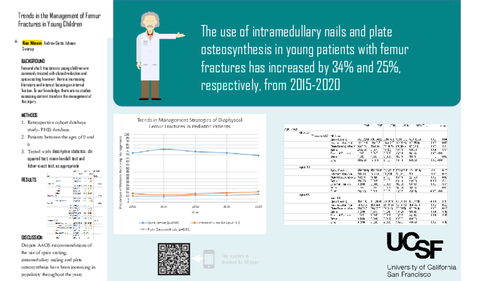
Results: We identified 4608 patients with a femoral shaft fracture during the study period. The majority of patients were White (67.9%) followed by Black (18.1%), and Hispanic (17%). The majority of patients were treated with spica casting (n = 3398, 73.7%) followed by intramedullary fixation (n = 600, 13.0%) and plate osteosynthesis (n = 449, 9.7%). In this cohort, 3236 patients were between the ages of 1-3 years and 1372 patients were between the ages of 4-6 years. There was a significant difference in management between these two age groups with lower rates of spica casting in older patients (92.1% vs. 30.5%) and higher rates of intramedullary fixation (37.3% vs. 2.7%) and plate osteosynthesis (28.2% vs. 1.9%) (p < 0.01). There was a significant correlation with increasing rates of intramedullary fixation and plate osteosynthesis from 2016 to 2020 (p = 0.03 and 0.01, respectively), and a decrease in rate of spica casting over time (p = 0.04).
Conclusion: Femur fractures in young children are treated with spica casting, intramedullary nails, and plate osteosynthesis. There is a significant change in management over time, and children between the ages of 4 and 6 are more likely to be treated with intramedullary nails compared to younger children. Additional studies are needed to understand these trends as well as justify the increase in rates of intramedullary nails and plate osteosynthesis in young children.