145 posters, 12 topics, 25 sessions, 145 authors
ePostersLive by SciGen Technologies S.A. All rights reserved.
UCSF 2023 Inquiry Symposium
10 May | University of San Francisco

P063
Identifying Facilitators and Hindrances Influencing Patient Decision to Receive Labor Epidural Analgesia & Timeline of Antenatal Care Concerns From Patients' Perspectives
Poster Presenter
Authors
Part of Topic
Clinical & Translational Sciences
Title:
Identifying Facilitators and Hindrances Influencing Patient Decision to Receive Labor Epidural
Analgesia & Timeline of Antenatal Care Concerns From Patients' Perspectives
Authors: Kiana C. Nguyen, Pamela Huang, Ronald George, Won Lee
Introduction:
In obstetric care, a critical piece of shared decision making and informed consent is effective and
timely dialogue on risks, benefits, and appropriate expectations. Discussion on laboring pain
management is an important component, both because it is a significant concern for women
approaching delivery and because it is a potential source for either patient empowerment or a
sense of dissatisfaction surrounding birth (1, 2). Decision to receive labor epidural analgesia is
affected by the parturient’s perception and beliefs regarding epidural analgesia, which may vary
among individuals with different backgrounds. Moreover, prior research suggests that women
often are interested in and prefer to have education about laboring pain management options –
including neuraxial – during antepartum visits, but further data on optimal timing has never been
elucidated (3).
Hypothesis:
We hypothesized that pregnant patients only develop concerns for pain of childbirth in the latter
part of their pregnancy, namely in their third trimester.
Aims:
Aim 1 of our study is to understand the timing of various antenatal concerns, especially laboring
pain management, during pregnancy. Aim 2 is to ultimately contribute to future studies that will
lead to the development of intervention strategies that can optimize patient education and
decrease disparities in labor epidural use.
Methods:
This is the qualitative portion of a mixed-method study using semi-structured interviews with
primiparous parturients (n=16) at various gestational ages. All patients were recruited at UCSF
Mission Bay. An interview script was created and used for this study to ask about patients’
predominant thoughts, worries, and hopes surrounding their pregnancies. Interviews were
recorded, transcribed, and subjected to inductive and deductive thematic analysis.
Results:
Our preliminary study consisted of 16 primiparous patients ranging from age 25 to 52 years old.
Gestational age ranged from 8 to 35 weeks, with 6 first-trimester participants, 5 second-trimester
participants, and 5 third-trimester participants. Predominant topics of concern elucidated during
interviews included baby’s health and development, mental health, maternal health, lifestyle
changes, finding reliable information, and labor pain options. Patients cited concerns about both
maternal and fetal health and development most frequently during the first trimester, while pain
management concerns were discussed most frequently during the third trimester.
Conclusions:
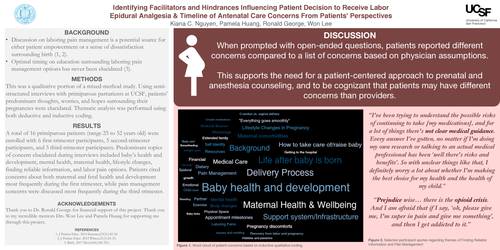
We found that participants prompted with open-ended questions reported different pregnancy
concerns compared to our list of concerns based on physician assumptions. This supports the
need for a patient-centered approach to prenatal and anesthesia counseling, and to be cognizant
that patients may have different concerns than providers. This is particularly true for laboring
pain management options, as patients may begin searching for information resources earlier in
pregnancy than providers may expect. We found that some parturients in their first or third
trimester had already expressed concerns regarding laboring pain management, suggesting a role
for decision-making aids on neuraxial analgesia as early as the first trimester. It is important to
capture the times at which parturients are most engaged and interested in learning about laboring
epidurals to understand the resources available at that time and to ensure informed and shared
decision making. Our study will further elucidate timing of labor pain concerns using
longitudinal surveys in the quantitative phase of our mixed-method study, ultimately aiming to
improve timing and implementation of prenatal counseling and decision aids for laboring
analgesia.
References:
1. J Perinat Educ. 2014 Summer;23(3):142-50.
2. J Perinat Educ. 2012 Winter;21(1):24-35.
3. Birth. 2017 Dec;44(4):345-351.