145 posters, 12 topics, 25 sessions, 145 authors
ePostersLive by SciGen Technologies S.A. All rights reserved.
UCSF 2023 Inquiry Symposium
10 May | University of San Francisco

P062
Creation and Evaluation of a Novel Pipeline Mentorship Program for Underrepresented in Medicine Anesthesia Residents Pursuing Fellowship Training
Poster Presenter
Authors
Part of Topic
Education Science
Introduction: The population served under the broad scope of anesthesia is, certainly, diverse
in relation to race, ethnicity, gender, and sexual orientation. To ensure high quality, equitable
care, it is important for the physicians serving these patients to reflect the same level of
diversity. Numerous studies have suggested that there are measurable benefits to diversifying
the workforce of practicing physicians. Diversity in healthcare has been shown to improve
productivity, clinical decision-making, patient outcomes, and safety. 1
Over the years, there has been an increase in the number of anesthesia residents entering
fellowships. Despite this increase, the number of fellows that identify with underrepresented in
medicine (URiM) groups, which includes Black, Native American, Hispanic, Native Hawaiian, and
Pacific Islander, remains low. Between 2000-2018, the number of pediatric anesthesiology
fellows increased from 57 trainees to 202 trainees, with the increase mostly attributed to an
increase in the number of white trainees. Over this period, the proportion of black trainees
decreased from 7% to 4.5% and other minority groups decreased from 12.3% to 10.9%. 2 From
2019-2020, it was reported by the ACGME that of 220 adult cardiothoracic anesthesia fellows, 7
identified as Hispanic, 6 identified as Black, and 1 identified as Native Hawaiian/Pacific
Islander. 3
To increase URiM representation in fellowship/subspecialty training, faculty within the UCSF
Department of Anesthesia created a novel URiM Mentorship Program that matched non-UCSF
anesthesiology residents with mentors chosen from UCSF faculty. Literature review supported
the notion that this program was, indeed, novel, and no similar program, that we know of,
exists. Mentors provided support by facilitating networking opportunities, offering feedback on
personal statements, reviewing CVs, and providing feedback on interviewing skills. Their focus
was to help their resident mentee become more prepared and competitive for the fellowship
match. Following the program’s pilot year, we set out to evaluate the effectiveness and utility
of this type of program.
Methods: Standards from the American Evaluation Association were used to create a formal,
formative program evaluation project rooted in Use-branch evaluation theory. The mentors and
residents who participated in the mentorship program were electronically sent an IRB-
exempt/approved Qualtrics survey that collected data on usefulness of the program and
resident perspective on perceived barriers.
Results: The aims of our study are to 1) assess the components of the mentorship relationship
that residents felt were most helpful in the fellowship match process 2) develop a better
understanding of the barriers to URiM anesthesiology resident success in the fellowship match.
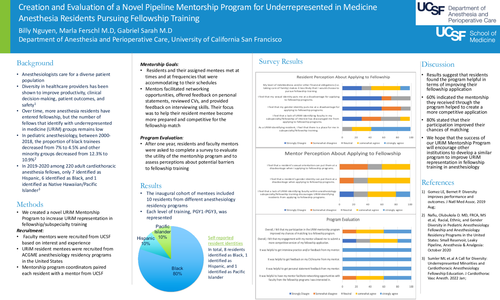
Ten mentor/mentee pairings were formed in the program’s pilot year. Of the 10 residents that
participated, 8 identified as Black/African-American, 1 identified as Hispanic/Latinx, and 1
identified as Asian (Filipino, Vietnamese, or Hmong only). Based on the survey results, 60% of
the participants indicated that the mentorship they received helped to create a more
competitive application and 80% stated that their participation improved their chances of
matching to fellowship.
Discussion: We believe that the this URiM Pipline Mentorship program was successful in
helping URiM-residents successfully match to the fellowships of their choice. Moving
forward, we plan to continue the program out of UCSF, with recruitment already underway,
and to help other institutions implement a similar mentorship program to support their
URiM residents.
References:
1. Gomez LE, Bernet P. Diversity improves performance and outcomes. J Natl Med Assoc. 2019 Aug;
2. Nafiu, Olubukola O. MD, FRCA, MS et.al, Racial, Ethnic, and Gender Diversity in Pediatric Anesthesiology Fellowship and
Anesthesiology Residency Programs in the United States: Small Reservoir, Leaky Pipeline, Anesthesia & Analgesia: October 2020
3. Sumler ML et.al A Call for Diversity: Underrepresented Minorities and Cardiothoracic Anesthesiology Fellowship Education. J
Cardiothorac Vasc Anesth. 2022 Jan;