145 posters, 12 topics, 25 sessions, 145 authors
ePostersLive by SciGen Technologies S.A. All rights reserved.
UCSF 2023 Inquiry Symposium
10 May | University of San Francisco

P055
Implementation of a novel electronic handoff tool in ICU-to-ward transitions of care
Poster Presenter
Authors
Part of Topic
Education Science
Title: Implementation of a novel electronic handoff tool in ICU-to-ward transitions of care
Authors: Emma McCune, Elle Fukui, Emily Harris, MD; Ella Cornell, MD; Patrick G. Lyons, MD,
MSc; Juan C. Rojas, MD; Lekshmi Santhosh, MD, MAEd
Introduction
The transition of hospitalized patients from the intensive care unit (ICU) to the inpatient ward is
a particularly high-risk period due to medical complexity, reduced monitoring, and diagnostic
uncertainty. Miscommunication during clinician handoff (e.g. missing or unclear information,
ambiguous responsibility for patients) increases the likelihood of medical errors and adverse
events (Lyons et al., 2016), as well as cognitive errors such as anchoring bias and premature
closure. Although standardized handoff processes are known to reduce medical errors and
adverse outcomes (Starmer et al., 2014), these approaches are understudied at the ICU-ward
interface, which remains vulnerable to non-standard and suboptimal practices (van Sluisveld et
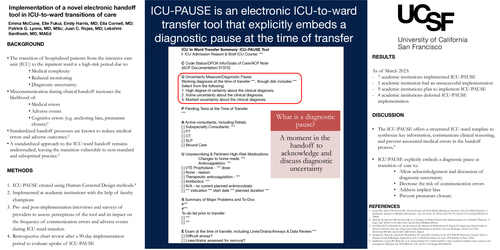
al., 2017). The ICU-PAUSE is a user-centered, electronic ICU-to-ward transfer tool created
using Human-Centered Design methods with focus groups of Internal Medicine residents across
three academic medical centers (Santhosh et al, 2022) (Figure 1). It explicitly embeds a
diagnostic pause at the time of transfer of care, acknowledging that this is a high-risk period for
patients.
Aims:
The aims of this implementation project are to 1) evaluate the feasibility, acceptability, and
adoption of implementing ICU-PAUSE into the ICU-WARD physician transfer workflow in a
diverse group of hospitals and 2) examine the perceived impact of ICU-PAUSE on
communication failures and associated medical errors during ICU-WARD transfers among
internal residents, ICU physicians, and ward physicians.
Methods:
This mixed-methods study will include a combination of a chart review, quantitative surveys, and
qualitative surveys. After a 90-day implementation period, we will conduct a retrospective chart
review to evaluate uptake of ICU-PAUSE. We will conduct postimplementation interviews and
surveys of providers to assess perceptions of the tool and its impact on the frequency of
communication errors and adverse events during ICU-ward transfers.
Results:
Between March 2022 and March 2023, seven academic institutions implemented ICU-PAUSE
as an ICU-ward handoff tool. As of March 2023, nine academic institutions are planning to
implement ICU-PAUSE. Four academic institutions deferred ICU-PAUSE implementation.
Preliminary qualitative data from post-implementation interviews show that implementation of
ICU-PAUSE was successful at five of the six interviewed sites.
Discussion:
The ICU-PAUSE offers a structured ICU-ward template to synthesize key information,
communicate clinical reasoning, and prevent associated medical errors in the handoff process
(Santhosh et al., 2019). ICU-PAUSE explicitly embeds a diagnostic pause at transition of care,
allowing acknowledgement and discussion of diagnostic uncertainty to decrease the risk of
communication errors, address implicit bias, and prevent premature closure.