145 posters, 12 topics, 25 sessions, 145 authors
ePostersLive by SciGen Technologies S.A. All rights reserved.
UCSF 2023 Inquiry Symposium
10 May | University of San Francisco

P057
Youth Advisory Groups in Health Research: A Review of the Literature and Synthesis of Promising Practices
Poster Presenter
Authors
Part of Topic
Clinical & Translational Sciences
Introduction: Youth advisory groups (YAGs), are being increasingly implemented across disciplines to elevate youth input and voice. As YAGs in health research expand, there is also a growing need to understand the current landscape and the different uses and structures of these advisory groups. However, the literature about the processes and impact of YAGs in health research is limited and challenging to find with practices often embedded within publications about the research project. As institutions, researchers, and funding agencies continue to recognize and prioritize the importance of youth experience in health research, a review of promising practices in implementing, facilitating, and sustaining YAGs in health research will be useful to other research projects and teams and may lower perceived barriers to launching YAGs.
Question: What are the promising practices and ongoing gaps in the academic literature of implementing, facilitating, and sustaining YAGs used in health research?
Aims: To compile promising practices for creating and sustaining YAGs for health research. Identify gaps in the literature surrounding YAGs for health research. Create recommendations for research involving YAGs for health research.
Project Design/Methods: To perform our review, we identified a selection of articles found in the paper, A scoping review of youth advisory structures in the United States: Applications, outcomes, and best practices, by Haddad et al. (2022), which reviewed the academic peer-reviewed literature for papers involving youth advisory structures in the United States. Of the 52 articles from the Haddad et al. (2022) review, 1 was excluded because it could not be accessed. With the addition of two outside articles (which were found from prior team knowledge of the article and from a preliminary search on PubMed) a total of 53 articles were read fully for eligibility. Our selection criteria included articles that were in the English-language or had a translation available. Articles had to mention a youth group that was advising health research processes and excluded clinical operations, intervention design, or quality improvement projects. Papers that mentioned a YAG participating in the research process were included. To be considered a YAG, the group had to be made up of majority 12–24-year-old individuals. We were also open to all types of peer-reviewed literature in scholarly academic journals. Selected eligible articles were analyzed through an inductive analysis approach. In addition, all 53 articles were read to distill YAG practices for the creation of a document of general promising practices emerging from the literature on YAGs.
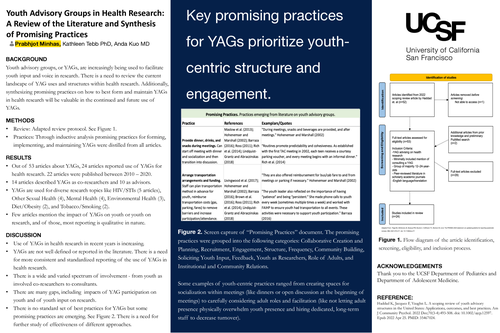
Primary Results: We identified 53 articles about YAGS with a total of 24 (45%) articles that reported use of a YAG for health research purposes. These 24 studies were published between 2002 and 2020. Twenty-two (92%) articles were published between 2010 – 2020, with the most articles published in 2017. Within the articles, 14 of the 24 articles (58%) described YAGs as co-researchers, while 10 (42%) described youth as consultants for advice. Of the 10 articles that used youth in a consultant role, 4 articles only mentioned or thanked the use of a YAG in the study with little to no detail. YAGs were used for a variety of health research topics. Within the articles, YAGs were used for advising health research topics like: HIV/STIs (5 articles, 21%), Other Sexual Health (4 articles, 17%), Mental Health (4 articles, 17%), Environmental Health (3 articles, 13%), Diet/Obesity (2 articles, 8%), Tobacco/Smoking (2 articles, 8%), Multiple Projects (3 articles, 13%), or Health Advocacy (1 article, 4%). Other preliminary results that are pending further analysis include that, notably, few articles talked about the impact of the YAG on the youth themselves, and of these articles, most described impacts in qualitative measures, not quantitative measures. Additionally, within the literature, not all articles mentioned how the YAG specifically impacted the research. The articles that mentioned YAGs impact typically reported using qualitative measures. The articles showed that there is much variance in how YAGs for health research are created, organized, and facilitated; however, some more commonly used practices are emerging. We created a summary of promising practices in establishing and maintaining YAGs. These promising practices are grouped into the following categories: Collaborative Creation and Planning; Recruitment; Engagement; Structure; Frequency; Community Building; Soliciting Youth Input; Feedback; Youth as Researchers; Role of Adults; and Institutional and Community Relations.
Discussion/Conclusion: This review reveals important insights into the current landscape and existing gaps within the academic literature regarding YAGs for health research in the United States. Within the literature, we found a need for more rigorous, consistent, and standardized reporting of the use of YAGs in health research including how studies acknowledge their involvement in the research process. The review also showed that there is a wide spectrum of involvement and structures for youth advising in research. Some YAGs were used as co-researchers for research, being deeply involved from the beginning of a research concept, while other YAGs were used to advise on one aspect of a project. There is also wide variance in how much detail and description is provided surrounding the level of involvement of YAGs in the health research process. Additionally, more quantitative research about how YAGs impact health research outcomes and processes, as well as how the experience of being on a YAG affects youth development is needed. While there is no standard set of best practices in establishing, facilitating, and sustaining YAGs, some promising practices emerged from the literature. Key practices prioritized youth-centric structures and engagement. Examples of these practices include creating spaces for socialization within YAG meetings (like dinners or open discussion at the beginning of meetings) to carefully considering adult roles and facilitation (like not letting adult presence physically overwhelm youth presence and hiring dedicated, long-term staff to decrease turnover). Further research could investigate measuring and comparing the impact and effectiveness of different YAGs practices. This would be useful in creating an evidence base for institutions, funders, and researchers to move forward in sustainable and responsible use of YAGs. Limitations of this review include that not all articles pertaining to YAGs in the United States were found in the search of YAGs by the Haddad et al. (2022) group as evidenced by our addition of articles. Also, the search by Haddad et al. (2022) only spanned until December 2020. As a result, our findings do not reflect the literature published afterwards. We plan to continue a full analysis of the articles from our initial review of the Haddad et al. (2022) and other articles.
Reference: Haddad K, Jacquez F, Vaughn L. A scoping review of youth advisory structures in the United States: Applications, outcomes, and best practices. Am J Community Psychol. 2022 Dec;70(3-4):493-508. doi: 10.1002/ajcp.12597. Epub 2022 Apr 25. PMID: 35467024.