145 posters, 12 topics, 25 sessions, 145 authors
ePostersLive by SciGen Technologies S.A. All rights reserved.
UCSF 2023 Inquiry Symposium
10 May | University of San Francisco

P054
MRI simulation for breast cancer radiotherapy planning of poorly defined postoperative tumor cavities
Poster Presenter
Authors
Part of Topic
Clinical & Translational Sciences
Introduction:
Following breast conserving surgery, radiation therapy is an important part of multidisciplinary
management of breast cancer. For patients requiring a tumor cavity boost or partial breast irradiation,
radiation therapy planning requires accurate delineation of the tumor cavity to deliver treatment to atrisk areas while sparing normal tissue. Delineation of the tumor cavity can be challenging due to poor
contrast on computed tomography (CT) between the normal glandular tissue and the tumor cavity.
Magnetic resonance imaging (MRI) provides excellent soft tissue contrast and is routinely used
diagnostically for breast imaging and may be especially helpful in the delineation of fluid-filled tumor
cavities, motivating the use of MRI simulation for breast RT planning.
Hypothesis:
The addition of MR images in the treatment planning process (particularly T2-weighted images) will aid
in visualizing and delineating the tumor cavities for post-resection breast cancer patients.
Aims:
• To examine the impact of the use of magnetic resonance imaging (MRI) simulation in addition to
conventional computed tomography (CT) simulation on radiation therapy (RT) planning
• To consider factors impacting MR image quality in this population
Project Design/Methods:
A breast MRI simulation protocol was developed on a 3T MRI simulator (MAGNETOM Vida, Siemens
Healthcare) in collaboration with radiologists, and utilized in patients with poorly defined TCs, as
determined by the treating radiation oncologist (RO). In this retrospective IRB-approved study, patients
who underwent breast CT and MRI simulation were identified in the electronic health record (EHR) and
the following information was collected: patient demographics, surgery type, tumor histology and
staging, tumor cavity volume, and MRI parameters. Sequences investigated include: T2 fat-saturated
free-breathing (FS FB), T2 HASTE breath-hold (BH), and T2 BLADE BH. Overall image quality for the T2-
weighted sequences was assessed by two ROs specializing in breast cancer, and a medical physicist
specializing in MRI, blinded to sequence type. The two ROs also assigned a cavity visualization score
(CVS) based on CT vs CT+MRI, when unblinded. Krippendorf’s alpha was used to quantify inter-rater
agreement on a scale from zero to one with one indicating perfect agreement.
Results:
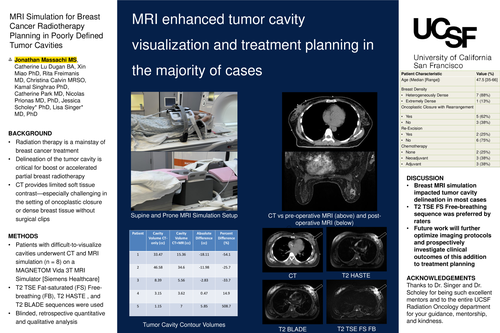
Eight patients underwent breast MRI simulation over a 6-month period. Median CVS was unchanged for
both raters with median CVS of 2, range [1-4] after the addition of MRI. The T2 FS FB sequence was
identified as the most useful sequence by all raters for all but one case, citing improved contrast and
sharpness, with Krippendorff's Alpha of 0.718. MRI produced images of sufficient quality for cavity
delineation in 6/8 patients. Of these, 5 patients had tumor cavity volumes contoured before and after
the availability of MRI data. For 80% of patients with available contour volumes (4/5), including MR in RT
planning contributed to an adjustment in the contoured tumor cavity volume greater than +/-25%.
Discussion:
In our initial experience of MRI simulation for breast RT planning, MRI contributed to changes in tumor
cavity volume in the majority of cases. This study was restricted to poorly-defined cavities, likely
contributing to low CVS ratings in both modalities. For cases where MRI was not immediately helpful,
later protocol optimization addressed issues encountered with both patients who had poor imaging
results. This cohort of cases with poorly-defined tumor cavities will provide important guidance to
prospective studies using our finalized imaging protocol to investigate feasibility and efficacy of breast
MRI simulation for RT planning.