145 posters, 12 topics, 25 sessions, 145 authors
ePostersLive by SciGen Technologies S.A. All rights reserved.
UCSF 2023 Inquiry Symposium
10 May | University of San Francisco

P050
Changes in lean mass, strength, and physical performance after laparoscopic sleeve gastrectomy surgery for severe obesity
Poster Presenter
Authors
Part of Topic
Clinical & Translational Sciences
Introduction
Given many people with obesity do not achieve sufficient weight loss through lifestyle modifications
alone, there has been increasing interest in surgical weight loss procedures, collectively termed bariatric
surgery.1 It is well-known that bariatric surgery leads to substantial weight loss primarily due to a
decrease in fat mass,2–4 with resulting improvements in obesity-related comorbidities, patient-reported
quality of life, and long-term survival.5,6 However, with loss of fat mass there is also a significant
postoperative decrease in lean mass, which has potential negative implications for strength and physical
performance. That said, strength and physical performance might be positively influenced by post-op
improvement in lipid accumulation within the muscle, known as myosteatosis, which is associated in
older adults with decreased strength and mobility7,8 and increased fracture risk9–11 but unexplored in the
settings of severe obesity and bariatric surgery.
Hypothesis
We hypothesize that muscle cross-sectional area and absolute muscle strength will decrease after
sleeve gastrectomy. We hypothesize that myosteatosis will improve post-op, as will physical
performance, and that improvement in myosteatosis is associated with post-op changes in strength and
performance.
Aims
1. Characterize changes in whole-body lean mass, and in cross-sectional area and myosteatosis of
thigh and abdominal muscles after sleeve gastrectomy.
2. Characterize how measures of strength and physical performance change after surgery.
3. Evaluate myosteatosis as a potential determinant of changes in strength and physical performance.
Methods
This project was an ancillary analysis of a prospective observational cohort study of the effects of sleeve
gastrectomy on calcium metabolism and skeletal health. Participants were adults with severe obesity
planning laparoscopic sleeve gastrectomy with their surgeons at the University of California, San
Francisco. Exclusion criteria included peri-menopausal status, prior history of bariatric surgery, comorbid
disorders including intestinal malabsorption, and use of medications known to impact bone metabolism.
Measurements were performed pre-op and at 6-months and 12-months post-op. At each timepoint,
participants underwent anthropometrics, dual-energy X-ray absorptiometry (DXA), quantitative computed
tomography (QCT), and strength and physical performance testing. Outcome variables of interest
included DXA-measured total body fat and lean mass, QCT-measured cross-sectional muscle area (cm2)
and density (Hounsfield Units), grip strength quantified using a dynamometer, and physical performance
defined by 4-meter gait speed, 400-meter walk time, and number of chair stands completed in 10
seconds. Paired t-tests and Wilcoxon tests were performed to assess for statistical differences between
outcome variables. Adjusted partial Spearman’s tests were used to assess for correlations.
Results
Fifty-three participants underwent pre-op and at least one post-op radiographic assessment of body
composition (DXA and/or QCT). Most participants were women (77%), of whom 63% were pre-
menopausal. Most were white (70%). Mean age was 46 years and median pre-op BMI was 45 kg/m2.
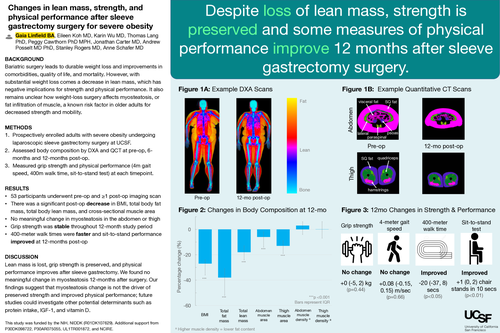
Body composition changed markedly during the 12 months after sleeve gastrectomy, with the greatest
rates of change occurring during the first 6 months (Table 1). Median BMI decreased from 43 kg/m2 pre-
op to 31 kg/m2 and 30 kg/m2 at 6 and 12 months, respectively (p<0.001 for both). There was a
substantial decrease in total body fat mass by 38% (interquartile range 31-52%) and lean mass by 18%
(IQR 12-24%) 12-months after sleeve gastrectomy (p<0.001 for both). Cross-sectional muscle area
decreased significantly in the abdomen and in the thigh (p<0.001 for both) over 12 months. There was no
meaningful change in myosteatosis of the thigh (median +0 HU, 95% CI -1 – 3 HU) or abdomen (+1 HU,
95% CI 0 – 2 HU) over 12 months.
Absolute grip strength was stable over the 12-month study period. Participants were significantly faster at
completing the 400m walk (by 20 sec, p<0.05) and had improved sit-to-stand performance (1 additional
chair stands per 10 sec, p<0.001). 4m gait speed did not change after surgery. Change in myosteatosis
was not correlated with change in grip strength, 400-meter walk time, or sit-to-stand performance (r= -
0.32 to +0.36, p>0.05 adjusted for age, sex, and menopause).
Discussion
We demonstrate that despite loss of lean mass and cross-sectional area, strength is preserved and
some measures of physical performance improve 12-months after sleeve gastrectomy. Our study is the
first to employ CT measures of muscle density to estimate myosteatosis in the abdomen and thigh in a
bariatric surgery population of mostly middle-aged adults, with prior studies having focused on older
adults. Although we hypothesized that improvements in myosteatosis might counteract the anticipated
loss of muscle, we found no meaningful change in myosteatosis at 12-months post-op. Our findings
suggest that decreased myosteatosis is not the driver of preserved strength and improved physical
performance post-op, paving the way for future studies to identify other determinants of neuromuscular
function in this group such as protein intake, vitamin D or IGF-1.