145 posters, 12 topics, 25 sessions, 145 authors
ePostersLive by SciGen Technologies S.A. All rights reserved.
UCSF 2023 Inquiry Symposium
10 May | University of San Francisco

P046
Patterns of Postoperative Trismus Following Mandibulectomy and Fibula Free Flap Reconstruction
Part of Topic
Clinical & Translational Sciences
Introduction: Trismus, or restricted mouth opening, is an increasingly recognized condition among patients with head and neck cancer (HNC). The impact of trismus on quality of life can be devastating, including marked limitations in communication, inadequate nutrition, and chronic pain, which predispose to social isolation and depression1–3. While radiotherapy (RT) has a wellrecognized and dose-dependent relationship with trismus in HNC patients, the influence of surgical interventions on trismus is less clear4–6. It is essential to identify the surgical factors that predispose to trismus, so that oncologic resections may be modified to optimize functional outcomes. One surgical cohort that may be especially susceptible to postoperative trismus are patients undergoing mandibulectomy with fibula free flap reconstruction (FFFR). These patients represent a unique challenge in the early postoperative period, as physicians may be reticent to initiate early jaw stretching exercises out of concern for stressing the newly placed bone graft. There is little data on the prevalence of trismus in patients with significant mandibular resection (i.e., segmental mandibulectomy resulting in a bony continuity defect).
Question and Aims: What is the scope of trismus in patients after mandibulectomy and FFFR? What demographic and treatment-related factors are associated with worse trismus outcomes?
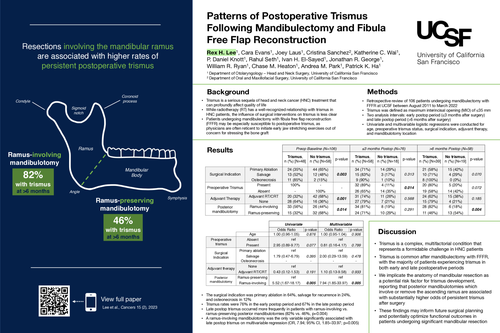
Methods: Retrospective review identified patients who underwent segmental mandibulectomy with FFFR at UCSF between August 2011 to March 2022. Trismus was defined as a maximum interincisal opening (MIO) of ≤35 mm7,8. The presence or absence of trismus was analyzed at two intervals: an early post-operative period (≤3 months after surgery) and a late postoperative period (>6 months after surgery). The absolute change between preoperative MIO and the MIO at most recent follow-up was defined as ∆MIO. Sites of the anterior and posterior mandibulotomies were recorded and broadly divided into “ramus-involving” and “ramuspreserving” cuts. “Ramus-involving” cuts were defined as mandibulotomies that removed any part of the ascending ramus; these cuts were either entirely superior and posterior to the mandibular angle, or they began at the angle and traversed superiorly/posteriorly to involve a portion of the ascending ramus. In contrast, “ramus-preserving” mandibulotomies involved only the angle or were positioned anterior to the angle. Logistic regression was performed with the binary outcome of yes/no trismus >6 months postoperatively, using the most recent MIO available. Univariate logistic regressions were conducted for age, preoperative trismus status, surgical indication, adjuvant therapy, and mandibulotomy location. Multivariable analysis was also conducted with the same variables.
Results: Of all charts reviewed, 106 patients undergoing mandibulectomy with FFFR met study criteria. The surgical indication was primary ablation in 64%, salvage for recurrence in 24%, and osteonecrosis in 12%. Forty-five percent of patients had existing preoperative trismus, and 58% of patients received adjuvant radiation/chemoradiation following surgery. The overall rates of post-operative trismus were 76% in the early postoperative period (≤3 months after surgery) and 67% in the late postoperative period (>6 months after surgery). Late postoperative trismus occurred more frequently in patients with ramus-involving vs. ramuspreserving posterior mandibulotomies (82% vs. 46%, p=0.004). A ramus-involving mandibulotomy was the only variable significantly associated with trismus >6 months postoperatively on multivariable logistic regression (OR, 7.94; 95% CI, 1.85–33.97; p=0.005).
Discussion: Trismus is a complex, multifactorial condition that represents a formidable challenge in patients with HNC. In this study, we demonstrate that trismus is common after mandibulectomy with FFFR, with the majority of patients experiencing trismus in both early and late postoperative periods. We implicate the anatomy of mandibular resection as a potential risk factor for trismus development, reporting that posterior mandibulotomies which involve or remove the ascending ramus are associated with substantially higher odds of persistent trismus after surgery. Largerscale studies are critical for identifying patients at the highest risk of trismus after mandibulectomy with FFFR, and delineating precise temporal changes in mouth opening may inform key postoperative intervals for active trismus intervention.
Publication: Lee RH, Evans C, Laus J, Thompson M, Wai KC, Knott PD, Seth R, El-Sayed IH, George JR, Ryan WR, Heaton CM, Park AM, Ha PK. Patterns of Postoperative Trismus Following Mandibulectomy and Fibula Free Flap Reconstruction. Cancers, 15 (2), 536. PMID: 36672485 (January 2023).
References: 1. Lydiatt, W. Trismus: A Sequela of Head and Neck Cancer and Its Treatment. JCO Oncol Pract 16, 654–655 (2020). 2. Johnson, J., Johansson, M., Rydén, A., Houltz, E. & Finizia, C. Impact of trismus on healthrelated quality of life and mental health. Head Neck 37, 1672–1679 (2015). 3. Lee, L. Y., Chen, S. C., Chen, W. C., Huang, B. S. & Lin, C. Y. Postradiation trismus and its impact on quality of life in patients with head and neck cancer. Oral Surg Oral Med Oral Pathol Oral Radiol 119, 187–195 (2015). 4. Abboud, W. A. et al. Restricted Mouth Opening in Head and Neck Cancer: Etiology, Prevention, and Treatment. JCO Oncol Pract 16, 643–653 (2020). 5. Ichimura, K. & Tanaka, T. Trismus in patients with malignant tumours in the head and neck. J Laryngol Otol 107, 1017–1020 (1993). 6. Goldstein, M., Maxymiw, W. G., Cummings, B. J. & Wood, R. E. The effects of antitumor irradiation on mandibular opening and mobility: a prospective study of 58 patients. Oral Surg Oral Med Oral Pathol Oral Radiol Endod 88, 365–373 (1999). 7. Dijkstra, P. U., Huisman, P. M. & Roodenburg, J. L. N. Criteria for trismus in head and neck oncology. Int J Oral Maxillofac Surg 35, 337–342 (2006). 8. Scott, B., Butterworth, C., Lowe, D. & Rogers, S. N. Factors associated with restricted mouth opening and its relationship to health-related quality of life in patients attending a Maxillofacial Oncology clinic. Oral Oncol 44, 430–438 (2008).