145 posters, 12 topics, 25 sessions, 145 authors
ePostersLive by SciGen Technologies S.A. All rights reserved.
UCSF 2023 Inquiry Symposium
10 May | University of San Francisco

P045
Daytime Breathing Disturbances at High-Altitude in a Healthy Cohort
Part of Topic
Clinical & Translational Sciences
Introduction:
Acute mountain sickness (AMS) is the most common form of high-altitude illness, which affects
more than 25% of individuals ascending to 3500m or above. AMS can present with a host of
symptoms, including nausea, vomiting, dyspnea, fatigue, and dizziness. AMS can even result in
sleep disturbances, which can present with apneic events, hypopneic events, and periodic
breathing - an oscillatory breathing pattern with periods of hyperventilation and intervals of
central apneas. These findings have been described to arise during sleep though we had
observed at altitude that these breathing disturbances could be observed in participants while
alert.
Hypothesis:
There is a positive correlation between daytime breathing disturbances and development of
AMS.
Aims:
1. To examine characteristics of participants who develop AMS compared to those who
don’t.
2. To identify any existing correlation between presence of daytime periodic breathing and
development of AMS.
3. To identify any existing correlation between presence of daytime apneic and hypopneic
events and development of AMS.
Project Design/Methods:
Sample
- Healthy participants aged 18-55 with primary residence of 1000ft elevation or lower and
no ascension to altitude of >10000ft within 4 months prior to screening. Participants were
excluded if they were taking a medication other than birth control and/or had other
significant health concerns.
- This study was conducted as a secondary analysis of a double-blind, randomized,
placebo-controlled phase 3 study of the efficacy of T89 – a modernized industrialized
version of a traditional Chinese herbal medicine – in preventing AMS.
Setting
- White Mountain Research Station (3800m, 12470ft) for 3 nights and 4 days
- Ascended from sea level to altitude within 8-10 hours on day 1.
Measurement Tools
- Using the Intellivue Biometric Monitoring System (IBMS), we collected 10 minutes of
participant breathing patterns at rest on each of the days at altitude (3 days total, last
day was not collected). Participants were instructed to sit and breathe as they usually do
without excessive movement for ten minutes. IBMS system is equipped with pulse-ox –
used to identify oxygen saturation – and ECG leads – used to approximate thoracic
movement as an indicator of breathing behavior.
- Lake Louise Score was used to determine if participants had developed AMS or not. A
score of at least 2 with at least 1 point for headache is considered positive for AMS.
Data Analysis
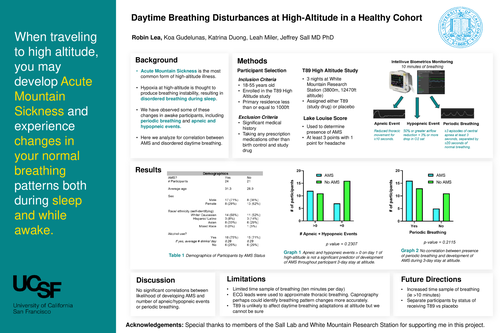
- All breathing abnormalities were identified manually. Definitions below:
o Apneic events – cessation of breathing for at least 10 seconds
o Hypopneic events – a 50% or greater decline in respiratory amplitude associated
with a 3% drop in oxygen saturation from baseline (ie within the previous 2
minutes of breathing).
o Periodic breathing – defined as an oscillatory breathing pattern with 3 or more
episodes of central apnea lasting at least 3 seconds, separated by no more than
20 seconds of normal breathing.
- Significance was determined using Fischer’s test.
Results/Product:
- Total of 45 participants with average age of 30.2, with 56% who identify as male and
44% who identify as female. White/ Caucasian-identifying individuals were the highest
self-identified ethnicity (53%), followed by Asian (31%), Hispanic/ Latino (13%), and
mixed race (2%).
- 47% of participants developed AMS. Demographic distribution between the group that
developed AMS and those that did not was largely similar. The most noticeable
difference between the two was sex-based (71% male, 29% female in the group that
developed AMS and 38% male, 62% female in those that did not).
- There is no significant correlation between the presence of apneic and hypopneic events
on day 1 at altitude (p = 0.2307) or on day 1-3 (cumulative events) at altitude (p =
0.2124) and development of AMS.
- There is no significant correlation between presence of periodic breathing and
development of AMS (p = 0.2115).
Discussion/Conclusion:
Interpretation
- There are no significant correlations between the likelihood of developing AMS and any
of the studied breathing abnormalities.
Major limitations
- There was a limited sample of breathing taken from each participant per day – ie only 10
minutes. This may not be a sufficient enough sample to detect any significant daytime
breathing abnormalities.
- Measurement of breathing patterns was performed indirectly through ECG leads that
were used to approximate thoracic movement.
- Participants were all enrolled in a double-blind, randomized trial and received either T89
or placebo. Although T89 is not known to affect breathing during the daytime, we cannot
be sure.
Next directions
- Increasing the time of breathing sampled from each participant (ie from 10 to 30
minutes) to capture breathing abnormalities.
- Increasing the number of participants to increase the power of the study.
- Capnography as a measurement of respiratory patterns to provide a more direct means
of measurement of breathing patterns.
Resources
San T, Polat S, Cingi C, Eskiizmir G, Oghan F, Cakir B. Effects of high altitude on sleep and
respiratory system and theirs adaptations. ScientificWorldJournal. 2013 Apr 17;2013:241569.
doi: 10.1155/2013/241569. PMID: 23690739; PMCID: PMC3654241.
Shamim-Uzzaman, Q., Singh, S. & Chowdhuri, S. Hypopnea definitions, determinants and
dilemmas: a focused review. Sleep Science Practice 2, 7 (2018).
https://doi.org/10.1186/s41606-018-0023-1