145 posters, 12 topics, 25 sessions, 145 authors
ePostersLive by SciGen Technologies S.A. All rights reserved.
UCSF 2023 Inquiry Symposium
10 May | University of San Francisco

P044
Impact of Ultrasound LI-RADS Implementation on Hepatocellular Carcinoma Surveillance Adherence Rates at a Safety Net Healthcare System
Poster Presenter
Authors
Part of Topic
Clinical & Translational Sciences
Title:
Impact of Ultrasound LI-RADS Implementation on Hepatocellular Carcinoma Surveillance
Adherence Rates at a Safety Net Healthcare System
Introduction:
Hepatocellular carcinoma is the sixth most common cancer worldwide and the sixth most
common cause of cancer-related deaths in the United States. Although HCC rates have stabilized
in recent years, there has been a disproportionate burden of HCC incidence and mortality on
vulnerable populations at risk for experiencing health disparities. Ultrasounds have proven to be
an effective method for early HCC detection at minimal risk or cost, but only 30-40% of eligible
patients receive proper ultrasounds surveillance with even lower rates in vulnerable populations.
In 2017, the Ultrasound Liver Imaging Reporting and Data System (US LI-RADS) was
implemented to standardize ultrasound surveillance for HCC, but the impact of this system on
surveillance rates and clinical outcomes for HCC in vulnerable populations is yet unclear.
Aims:
We aimed to assess adherence to US LI-RADS and associated patient-level factors for HCC
surveillance at a safety-net healthcare system in San Francisco
Project Design/Methods:
This study was a retrospective cohort study of patients undergoing HCC ultrasound surveillance
at a single-center safety net hospital (Zuckerberg San Francisco General Hospital) from June 1st
2020 to February 28th 2021. Detailed demographic, clinical and liver-related data for the study
population was obtained through chart review of patient electronic medical records. Outcomes
were categorized as full adherence vs non- and partial adherence by first follow-up visit after
initial ultrasound exam. Descriptive analysis of the patient population was obtained through
summary statistics of demographic and clinical characteristics by adherence using ANOVA, ChiSquare and Fischer’s test, as appropriate. Multivariate logistic regression was performed to
assess for factors associated with adherence adjusted for age, sex, race, time since COVIDpolicy onset and factors found to be significant on univariate analysis (p < 0.10).
Results:
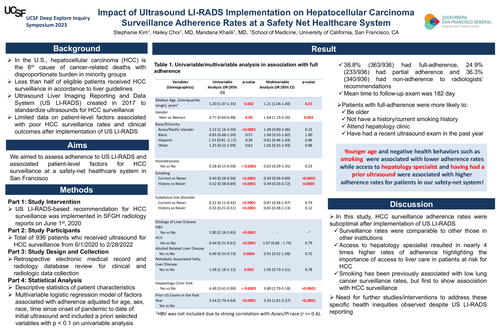
Of 936 patients, full adherence rates to radiologists’ recommendations from initial ultrasound
visit to follow-up visit were 38.8%. The median age was 60 years old, 56.7% men with more
than half of patients being Asian/Pacific Islander (58.1%). The majority of patients had hepatitis
B (60.6%) with 2 or more comorbidities (83.8%), and 58.2% of all patients attended hepatology
clinic. On multivariate analysis, older age (p = 0.01), attendance of hepatology clinic (p <
0.0001), and history of recent ultrasound exam (<0.0001) were positive predictors for full
adherence while history or current smoking (p = 0.0003, < 0.0001) were associated with
decreased adherence rates to US LI-RADS based HCC surveillance.
Discussion:
In this study, adherence to US LI-RADS based HCC surveillance remained suboptimal with a
full adherence of 38.7% even after implementation of US LI-RADS in our safety net healthcare
system. This study was able to identify significant risk factors associated with adherence in a
diverse, urban population. One of the strongest associations with full adherence to HCC
surveillance was patients’ attendance of hepatology clinics (OR 3.80). In our study, 41.8% of
patients did not engage with a hepatologist, comparable to other studies suggesting only 20-40%
of patients at risk for HCC are monitored by a specialist with more limited access in rural, safetynet or community hospitals. Smoking, which has been associated with lower rates to lung cancer
screening, was also seen as a significant risk factor for incomplete adherence to HCC
surveillance. Limitations to the study included the limited timeframe after US LI-RADS
implementation and the COVID-19 pandemic, although there was no effect when adjusting for
time since COVID-19 policy onset. Nevertheless, our study is the first to examine adherence to
US LI-RADS in a large, diverse population and highlights the need for further studies and
targeted interventions to improve health inequities surrounding ultrasound HCC surveillance.