145 posters, 12 topics, 25 sessions, 145 authors
ePostersLive by SciGen Technologies S.A. All rights reserved.
UCSF 2023 Inquiry Symposium
10 May | University of San Francisco

P043
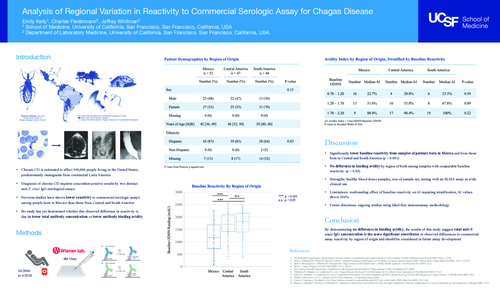
Analysis of Regional Variation in Reactivity to Commercial Serologic Assay for Chagas Disease
Poster Presenter
Authors
Part of Topic
Clinical & Translational Sciences
Introduction
Chagas disease (CD) is a neglected infectious disease caused by the protozoan parasite
Trypanosoma cruzi [1]. Chronic CD is estimated to affect 300,000 people living in the United
States (US), primarily immigrants from continental Latin America, where the parasite is
endemic, and leads to demonstrable end-organ damage in up to thirty percent of people affected
[2-4]. Diagnosis of chronic CD requires concordant positive results by two distinct anti-T. cruzi
IgG serological assays [5]. Previous studies have demonstrated lower reactivity to commercial
serologic assays among people born in Mexico than those from Central and South America [6,
7]. However, no study has yet elucidated whether this observed difference in reactivity is due to
lower total antibody concentration from lesser parasite exposure or lower antibody binding
avidity for regionally specific antigens used in commercial assays. The present study was
designed to interrogate the role of IgG binding avidity in serum reactivity by region of birth
using the Chagatest ELISA Recombinante v.3.0 (Weiner Lab, Argentina, FDA 510(k) clearance
in 2004).
Aims
- Describe serologic reactivity to commercial T. cruzi multiantigen by region of origin
- Determine if immunoglobulin binding avidity varies by region of origin
Project Design/Methods
Blood donor plasma samples were collected by the American Red Cross (ARC) between
September 2006 and June 2018, and T. cruzi seropositive specimens were provided frozen to
investigators with patient-reported age, sex, ethnicity and region of origin data. Reactivity was
determined by OD450 output from Chagatest ELISA Recombinante v.3.0 using standard clinical
operating procedure [8]. Binding avidity was interrogated by exposing samples to 4M urea,
previously described in HSV-1 as the urea dissociation plate method [9]. Avidity index (AI) was
calculated as OD450 output from sample exposed to 4M urea divided by OD450 output from the
same sample unexposed to urea (baseline OD450). AI was found to be strongly correlated with
baseline OD450, confounding the association of AI by region of origin. Stratification was
therefore employed to assess AI in comparable ranges of baseline reactivity: OD450 0.70-1.20,
1.20-1.70, 1.70-2.20. The Kruskal–Wallis H test (one-way ANOVA on ranks, non-parametric
method) was used to examine difference by region of origin in STATA 14.2. This research was
approved by the ARC institutional review board and was deemed exempt by the Human
Research Protection Program at the University of California, San Francisco (UCSF).
Results/Product
In total, 143 samples with previously identified T. cruzi seropositivity and patient birth in
continental Latin America were run by Weiner Chagatest ELISA Recombinante v.3.0 using the
urea dissociation plate method to estimate binding avidity. Of these, 52 (36%) reported birth in
Mexico, 47 (33%) in Central America, and 44 (31%) in South America. Sixty (42%) identified as
male, 112 (78%) identified as Hispanic, and the median age was 45 (interquartile range: 34, 53).
There was no difference in sex or age by region, but patients were less likely to identify as
Hispanic if born in South America (p < 0.05).
Reactivity, as measured by baseline OD450 reading, varied by country of origin with
significantly lower reactivity in samples from patients born in Mexico compared to those born in
Central and South America. In order to assess relative binding avidity by region, a subset of 108
samples with baseline OD450 readings between 0.70 and 2.20 were divided into three equal
strata for comparison of AI. AI above 100% was registered for 29 (20%) of samples in the
subset, of which 20/29 (69%) were in the highest baseline reactivity stratum. No difference in AI
was found among regions of origin in any stratum (p > 0.05).
Discussion/Conclusion
This study presents the first comparison of binding avidity for anti-T. cruzi IgG based on patient
region of birth. Using the commercially available Weiner Chagatest ELISA Recombinante v.3.0,
we describe significant differences in baseline reactivity between samples from patients born in
Mexico and those born in Central and South America but no difference in binding avidity by
region of birth among samples with comparable baseline reactivity.
Previous studies, including from this research group, have described variation in reactivity to
commercial multiantigen tests for T. cruzi by patient origin [6, 7]. Theories for this observed
difference include 1) lower reactivity represents weaker binding avidity of antibodies produced
against the strains of T. cruzi parasite endemic to Mexico, as T. cruzi parasites display regional
genetic clustering [10], and 2) lower reactivity is dependent on lesser total anti-T. cruzi IgG
concentration from reduced exposure to T. cruzi parasites in Mexico compared to more southern
parts of Latin America. Understanding the etiology of regional variation in reactivity is critical to
future diagnostic and screening test development, as differences in binding avidity support
investment in new commercial antigen development that targets North American parasite
epitopes, and differences in total antibody concentration support optimization of sample
preparation to increase total anti-T. cruzi IgG yield on existing commercial antigen assays.
Improving test performance for patients from Mexico is particularly important for reducing
health disparities caused by CD in the US considering this population represents the majority of
Latin American immigrants in the nation. By demonstrating no difference in binding avidity, the
results of this study suggest total anti-T. cruzi IgG concentration is the more significant
contributor to observed differences in commercial assay reactivity by region of origin and should
be considered in future assay development.
Strengths of this study include the use of healthy blood donor samples, the size of the sample set,
and testing by an ELISA assay in wide clinical use. Limitations include the confounding effect of
baseline reactivity on AI seen with the plate urea dissociation method, which required sub-setting
samples into lower powered strata. This increases the risk of Type-I error associated with our
finding of no difference in binding avidity. The urea dissociation plate method also produced AI
values above 100% with a bias towards higher reactivity samples, possibly due to liberation of
immunoglobulins otherwise ensnared in cryoprecipitate that aggregated during freeze-thaw. Our
research group is actively pursuing additional studies using label-free immunoassay
methodology to overcome these limitations and disentangle the confounding effect of baseline
reactivity on avidity index in order to compare across a wider range of sample reactivity.
Works Cited:
1. World Health Organization. Chagas disease in Latin America: an epidemiological update
based on 2010 estimates. Weekly Epidemiological Record 2015; 90(06): 33-44.
2. Irish A, Whitman JD, Clark EH, Marcus R, Bern C. Updated Estimates and Mapping for
Prevalence of Chagas Disease among Adults, United States. Emerg Infect Dis 2022;
28(7): 1313-20.
3. Bern C, Messenger LA, Whitman JD, Maguire JH. Chagas Disease in the United States: a
Public Health Approach. Clin Microbiol Rev 2019; 33(1).
4. Bern C. Chagas' Disease. N Engl J Med 2015; 373(5): 456-66.
5. Pan American Health Organization. Guidelines for the diagnosis and treatment of Chagas
disease. PAHO Washington, DC, 2019.
6. Whitman JD, Bulman CA, Gunderson EL, et al. Chagas Disease Serological Test
Performance in U.S. Blood Donor Specimens. J Clin Microbiol 2019; 57(12).
7. Kelly EA, Bulman CA, Gunderson EL, et al. Comparative Performance of Latest-
Generation and FDA-Cleared Serology Tests for the Diagnosis of Chagas Disease. J Clin
Microbiol 2021; 59(6).
8. Wiener Laboratorios S.A.I.C. Chagatest ELISA Recombinante v.3.0 [package insert].
2004.
9. Olsson J, Johansson J, Honkala E, et al. Urea dilution of serum for reproducible anti-
HSV1 IgG avidity index. BMC Infect Dis 2019; 19(1): 164.
10. Majeau A, Murphy L, Herrera C, Dumonteil E. Assessing Trypanosoma cruzi Parasite
Diversity through Comparative Genomics: Implications for Disease Epidemiology and
Diagnostics. Pathogens 2021; 10(2).