145 posters, 12 topics, 25 sessions, 145 authors
ePostersLive by SciGen Technologies S.A. All rights reserved.
UCSF 2023 Inquiry Symposium
10 May | University of San Francisco

P039
Utilizing a machine learning approach to identify risk factors associated with infantile epileptic spasms syndrome (IESS) treatment response
Poster Presenter
Authors
Part of Topic
Clinical & Translational Sciences
Introduction: Infantile epileptic spasms syndrome (IESS) is a rare epileptic disorder affecting young children that carries a severe prognosis. Early identification of IESS and initiation of appropriate medical treatments are necessary to mitigate adverse neurodevelopmental outcomes. While children with IESS have a greater than 70% response to initial therapy, 50% will relapse, which further increases risk of intractable epilepsy and intellectual disability. There is a need to risk-stratify children who fail initial therapy and who are at highest risk of relapse in order to trial novel therapeutic strategies in hopes of preventing recurrent seizures. Machine learning methods utilizing bioinformatics provide a novel approach to identifying possible risk factors associated with treatment failure and recurrence in children with IESS.
Hypothesis: We hypothesize that by utilizing a machine learning approach we will be able to identify pertinent factors associated with treatment response in children with infantile spasms.
Aims: We aim to compare the accuracy of different machine learning approaches to better predict treatment response in children with IESS.
Methods: This was a secondary analysis of the National Infantile Spasms Consortium’s (NISC) dataset, a prospective, multicenter cohort of children with IESS treated between 2012 and 2018. Children with new onset IESS between the ages of 2 months and 2 years, who received first line therapy with adrenocorticotropic hormone (ACTH), corticosteroids (prednisolone/prednisone), and/or vigabatrin (VGB)), and had outcome data at two-weeks were included. We used summary statistics to compare characteristics between responders and non-responders. Missing data was imputed via Multivariate Imputation by Chained Equations (MICE), including all univariate predictors of two-week treatment outcome (p<0.05), as well as pre-determined variables that had previously been shown to be associated with treatment response (race, insurance, distance from treatment center, prior seizures). We compared performance of stepwise logistic regression in predicting two-week treatment outcome versus several supervised machine learning classification techniques, including support vector machines and random forest. Models were compared by comparing the area under the receiver operator curve (AUROC) using the De Long method. We partitioned the imputed dataset, with 70% reserved for model testing/tuning, and 30% for testing of model performance. Analyses were performed using STATA 17.0 and R 4.2.3.
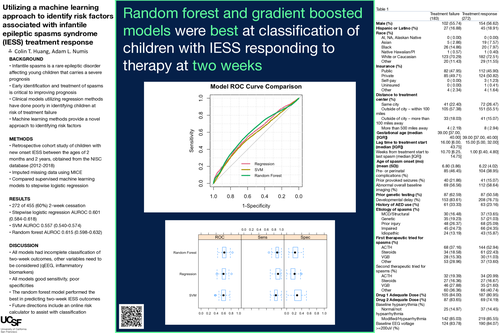
Results: Among 644 participants in the NISC database, 145 (23%) children did not have two-week outcome data and 44 (7%) did not receive first line therapy. Of 455 children including in this analysis, 272 (60%) of children had cessation of IESS within two weeks of first-line therapy initiation. There was a median of 15 days (Interquartile range (IQR) = 6-35) between diagnosis of IESS and treatment initiation. 212 of 455 (47%) of children were initially treated with ACTH, 95 (21%) with corticosteroids, and 58 (13%) with VGB. Baseline EEG data for children included 85% with hypsarrhythmia or modified hypsarrhythmia and 84% with EEG voltage ≥ 200uV. We included demographic variables, EEG criteria, seizure history, and therapies trialed in the final models. Stepwise logistic regression had a sensitivity of 0.91 and specificity of 0.21 for the twoweek outcome with a AUROC of 0.601 (95% Confidence interval (CI) 0.584-0.618). The support vector machine model had an AUROC of 0.557 (95% CI 0.540-0.574). The random forest model (AUROC 0.615 (95% CI 0.598-0.632) had improved classification compared to stepwise logistic regression (p<0.05). Significant predictors of two-week outcome from stepwise logistic regression were similar to predictors with high variable importance in the random forest model and included lag time from diagnosis to initial treatment initiation, etiology of spasms, distance from treatment center, and race.
Discussion: Among four supervised machine learning algorithms, random forest was the best at classification of children with IESS responding to to initial therapy at two-weeks. The random forest machine learning model performed better than stepwise logistic regression in prediction of two-week IESS outcomes, highlighting how random forest models may provide better insight into factors associated with IESS treatment response than standard logistic regression. The tradeoff of better prediction may be worse clinical interpretability. A limitation of this study is that our model was trained and tested on a singular data set, though we anticipate good external validity given the number of centers participating in NISC. Upon further validation, these models can be incorporated into online clinical calculators to help stratify those at highest risk of treatment failure at two-weeks. Future studies will also evaluate risk of IESS relapse by 3-months in those children with initial treatment response and may not perform as well on a different set of data.