145 posters, 12 topics, 25 sessions, 145 authors
ePostersLive by SciGen Technologies S.A. All rights reserved.
UCSF 2023 Inquiry Symposium
10 May | University of San Francisco

P036
Screening and treatment of depression after mild traumatic brain injury in an urban public health system
Part of Topic
Clinical & Translational Sciences
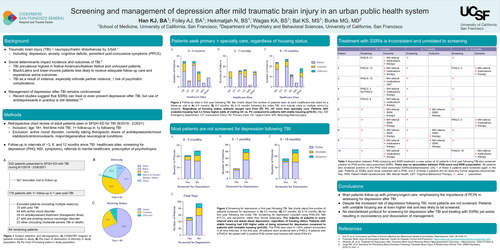
Background Half of patients with Traumatic Brain Injury (TBI) report some neuropsychiatric disorder, with depression being the most common psychiatric sequelae at 25-50% of all patients with a TBI. 1,2 Social determinants of health further impact the incidence and outcomes of TBI. For example, TBI prevalence is highest in Native American/Alaskan Native and unhoused patients; Black/Latinx and lower-income patients are less likely to receive adequate follow-up care and experience worse outcomes. 3 Many patients with a TBI are lost to follow up, especially without ubiquitous screening for depression after a TBI. Even so, management of depression after TBI remains controversial: namely that recent studies suggest that SSRIs can treat or even prevent depression, but use of antidepressants in practice is still debated. 4-8
Aims 1) characterizing clinician approaches to detecting and treating depression first-time mild TBI; 2) examine patterns of depression following mTBI within a year of injury; and 3) evaluating current interventions for depression after TBI, as well as barriers to treatment.
Methods Study design: a retrospective chart review of adult patients seen in the Zuckerberg San Francisco General Hospital (SFGH) Emergency Department (ED) for a first-time mild traumatic brain injury (between August 2019 and February 2021). This study was approved by the Institutional Review Board at the University of California, San Francisco. Inclusion criteria: age 18+, first-time mild TBI, at least 1 follow-up in the first year following index TBI. Exclusion criteria: at the time of index trauma: active mood disorder at the time of index trauma, currently taking therapeutic doses of antidepressants/mood stabilizers/anticonvulsants, and/or major/degenerative neurological conditions. Follow-up visits in the intervals of approximately 3, 6, and 12 months since TBI were reviewed for: healthcare sites, screening for depression (using the PHQ, NSI, and symptoms), referrals to mental healthcare, and prescription of psychotropic medications. Data analysis was carried out with Prism GraphPad.
Results 60 patients with first-time mild TBI were reviewed for 1 year after their TBI from a starting sample of 522 patients seen at SFGH ED for TBI, about ⅔ of which were excluded due to loss to follow up. Patients sought care from the emergency department and primary care (PC) and urgent care (UC more than specialty care, regardless of housing status. Patients with unstable housing had 3.2 times higher odds of visiting UC vs. PC compared to patients with stable housing (p=0.01). The majority of patients in every interval were not screened for depression, regardless of housing status. Patients with stable housing had 3.05 higher odds of being screened for depression compared to patients with unstable housing (p=0.03). The PHQ was used in less than 25% patient encounters in all time intervals. No patient with a positive PHQ screen was tracked with serial PHQ-9’s. There was no association between PHQ score and SSRI prescription. No patients who screened positive on the PHQ were prescribed SSRIs/antidepressants; only 1 of these 5 patients were screened again in the year. Patients on SSRIs were never screened with a PHQ, and 2 of these 4 patients did not have any formal diagnosis documented.
Discussion/Implications This is one of few studies that examined practices in managing mTBI sequelae in a public, low-income patient population. Most patients follow-up with primary/urgent care, emphasizing the importance of primary care providers in assessing depression after TBI. Despite the increased risk of depression following TBI, most patients are not screened. Patients with unstable housing are at even higher risk and less likely to be screened. No standardized protocol for screening for depression after TBI and treating with SSRIs yet exists, resulting in inconsistency and dissociation of management. While our study was limited by small sample size, largely due to loss to follow up, this only further highlights the need for intentional, streamlined, and protocolized care for patients after experiencing a TBI. This study will inform improvements in screening and care for depression after TBI for the unique patient population of SFGH and TBI survivors broadly.
References 1. Blennow, K. et al. Traumatic brain injuries. Nature Reviews Disease Primers 2016 2:1 2, 1–19 (2016). 2. Izzy S, et al. Concussion and Risk of Chronic Medical and Behavioral Health Comorbidities. Neurotrauma. 2021;38:1834–41. 3. Traumatic Brain Injury & Concussion [Internet]. Center for Disease Control and Prevention. https://www.cdc.gov/traumaticbraininjury/data/index.html 4. Albrecht JS, et al. Treatment of Depression after Traumatic Brain Injury Reduces Risk of Neuropsychiatric Outcomes. J Neurotrauma. 2020;37:2542–8. 5. Hart, T. et al. Early Trajectory of Psychiatric Symptoms after Traumatic Brain Injury: Relationship to Patient and Injury Characteristics. Journal of Neurotrauma 31, 610 (2014). 6. Jorge RE, et al. Sertraline for Preventing Mood Disorders Following Traumatic Brain Injury: A Randomized Clinical Trial. JAMA Psychiatry. 2016;73:1041–7. 7. Kreitzer, N. et al. The Effect of Antidepressants on Depression After Traumatic Brain Injury: A Meta-analysis. The Journal of head trauma rehabilitation 34, E47–E54 (2019). 8. Narapareddy, B. R. et al. Treatment of Depression After Traumatic Brain Injury: A Systematic Review Focused on Pharmacological and Neuromodulatory Interventions. Psychosomatics 61, 481–497 (2020).