145 posters, 12 topics, 25 sessions, 145 authors
ePostersLive by SciGen Technologies S.A. All rights reserved.
UCSF 2023 Inquiry Symposium
10 May | University of San Francisco

P035
Double Balloon Enteroscopy in HHT Patients: A Large Case Series
Poster Presenter
Authors
Part of Topic
Clinical & Translational Sciences
Introduction: Double balloon enteroscopy (DBE) with argon plasma coagulation (APC) has been shown to effectively treat small bowel GI bleeding but is not well studied in patients with Hereditary Hemorrhagic Telangiectasia (HHT).
Aims: Conduct a retrospective study of patients with HHT who underwent DBE at an academic referral center. Describe patient characteristics and changes in labs and transfusion requirements following DBE.
Methods: We reviewed medical records of all patients referred to the UCSF HHT Center of Excellence who underwent DBE from 2011 to 2021. Patient demographics, number of procedures, hemoglobin (Hb) and blood transfusion requirements in the years before and after DBE, distribution and burden of AVMs, medical therapy for AVMs as well as adverse events were collected. We used non-parametric univariate tests to assess associations with sex, genotype, age, smoking, lesion burden, and institution at which the procedure was performed.
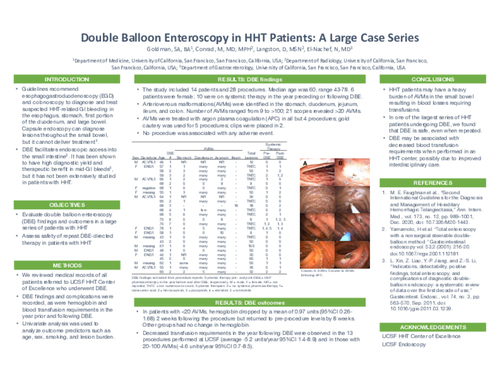
Results: The study included 14 patients and 28 procedures. Average number of procedures per patient was 2 and ranged from 1-7. Median age at first DBE was 57 (range 43-78). 6/14 patients were women, 9/14 had a history of smoking, and 10/14 were on systemic antifibrinolytic or antiangiogenic therapy at some point in the year preceding or following their DBE. Arteriovenous malformations (AVMs) were identified in the stomach, duodenum, jejunum, and ileum. Number of AVMs ranged from 9 to >100. 21/28 scopes revealed >20 AVMs, and 10 revealed too many AVMs to count. AVMs were treated with APC in all but 4 procedures; gold cautery was used for 5 procedures and hemoclips were placed in 2. No procedure was associated with any adverse event. In patients with ≤20 AVMs, Hb dropped by a mean of 0.97 units (95%CI 0.26-1.68) 2 weeks following the procedure but returned to pre-procedure levels by 8 weeks. Other groups had no change in Hb at 2 or 8 weeks. Decreased transfusion requirements in the year following DBE were observed for those with procedures that counted >20 AVMs (mean -4.6 units packed red blood cells (pRBC)/year 95%CI 0.7-8.5) and for procedures performed at UCSF (mean -5.2 units pRBC/year 95%CI 1.4-8.9).
Conclusions: Single and repeat DBE-directed treatment of small bowel AVMs is safe in patients with HHT and did not worsen bleeding. HHT patients in our cohort with 21-100 AVMs had decreased transfusion requirements following DBE. DBE may also be particularly helpful in decreasing transfusion requirements when performed in an HHT Center, possibly due to improved interdisciplinary care. This is the largest study to date examining findings and outcomes of DBE in patients with HHT; prospective studies will be required to optimize DBE in this population.