145 posters, 12 topics, 25 sessions, 145 authors
ePostersLive by SciGen Technologies S.A. All rights reserved.
UCSF 2023 Inquiry Symposium
10 May | University of San Francisco

P034
Outcomes After Open Reduction Internal Fixation of Ankle Fractures in Patient Based on Insurance Status
Poster Presenter
Authors
Part of Topic
Clinical & Translational Sciences
Introduction: Ankle fractures are a common orthopaedic injury, with an incidence of roughly 130,000 per year in the United States. These injuries occur throughout the general population involving those with and without insurance. Prior studies have concluded worse outcomes for uninsured and/or underinsured patients undergoing orthopedic surgeries, particularly for those undergoing elective procedures. Few studies have looked at the effect of insurance status on the outcomes after ankle open reduction internal fixation (ORIF). At our institution, fracture patients are treated by the same surgeons with similar protocols regardless of insurance status.
Hypothesis: We hypothesize that there will be no difference in clinical outcomes between underinsured and insured patients after ankle fracture surgery.
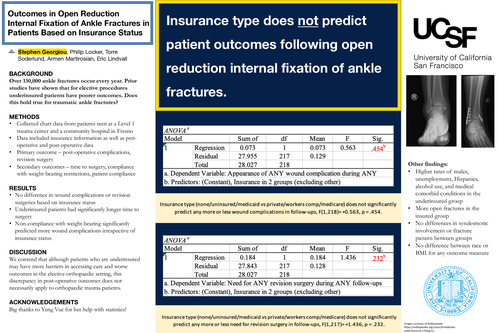
Aims: Elicit if there is a difference in post-operative outcomes between patients with ankle fractures who undergo open reduction internal fixation based on insurance status. Primary outcomes are post-operative complications including surgical site infection and re-operation rates. Secondary outcomes are time to surgery, compliance with weight bearing restrictions, and compliance with follow up.
Methods: The study included patients from a single institution at two hospitals, a Level-1 trauma center and a community hospital. Ankle fracture patients who underwent ORIF with two senior fellowship trained orthopaedic trauma surgeons were retrospectively reviewed from 2012-2020. Inclusion criteria were isolated ankle fracture, greater than 18 years of age, at least three months follow up, documented insurance, and surgical intervention. Exclusion criteria were patients less than 18 years of age, no documented insurance, follow up < 3 months, application of external fixation, polytrauma and injury to surgery time greater than 4 weeks. Patient demographics and injury characteristics were collected. Insurance status was recorded as private, Medicare, Medicaid, workers compensation, none/uninsured and other. Medicaid and uninsured patients were considered underinsured.
Results: From 2013-2020, there were 511 patients that underwent ORIF for ankle fractures from our senior authors. 211 patients met inclusion criteria, with 48 being underinsured. There were significantly higher rates of males, homelessness, Spanish speakers, substance abuse (alcohol, meth, marijuana), higher ASA class, hypertension, and hyperlipidemia in the underinsured group compared to the insured group. There were more open fractures and dislocations in the insured group. There were no differences in syndesmotic involvement or fracture pattern between groups. Insurance type does not significantly predict more or less wound complications (p=.45) or revision surgery (p=.23). Underinsured patients had significantly longer time to surgery compared to insured (p<.01). Those with more follow-up had significantly more revision surgery (p=.02). Wound complications were not associated with weight bearing compliance (p=.44), race (p=.051), or BMI (p=.21). Similarly, revision surgery was not associated with weight bearing compliance (p=.44), race (p=.38), or BMI (p=.95).
Conclusions: Our study demonstrated equivalent outcomes following ankle ORIF in patients regardless of insurance status. Prior studies, primarily in the elective setting, have presumed that patients who do not have insurance receive suboptimal care compared to those who have insurance. We contend that although patients who are underinsured may have more barriers in accessing care and worse outcomes in the elective orthopaedic setting, this does not necessary apply to orthopaedic trauma patients. We content orthopaedic trauma patients receive timely and effective care regardless of insurance status. Our study suggests that orthopaedic trauma patients' treatment algorithm and surgical approach is not influenced by monetary factors, race, or BMI.