145 posters, 12 topics, 25 sessions, 145 authors
ePostersLive by SciGen Technologies S.A. All rights reserved.
UCSF 2023 Inquiry Symposium
10 May | University of San Francisco

P033
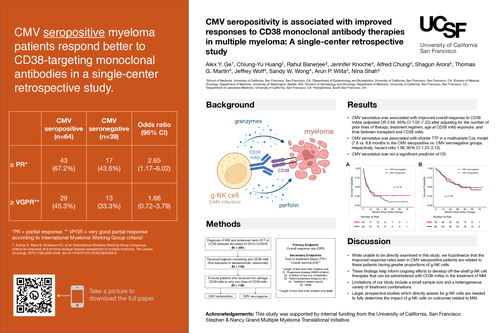
CMV seropositivity is associated with improved responses to CD38 monoclonal antibody therapies in multiple myeloma: A single-center retrospective study
Part of Topic
Clinical & Translational Sciences
Introduction: CD38-targeting monoclonal antibodies (CD38 mAbs) such as daratumumab and
isatuximab are well-established therapies in the treatment of multiple myeloma (MM). However,
many patients receiving CD38 mAbs eventually relapse on treatment, and thus there is a need
to identify methods to further enhance the efficacy of these drugs. Natural killer cells deficient in
FcRI (g-NK cells), which stably expand to form “memory-like” populations in those exposed to
cytomegalovirus (CMV), were found to dramatically potentiate the efficacy of daratumumab in a
prior in vivo study. To our knowledge, there are no clinical studies examining the association
between CMV serostatus and responses to treatment in MM.
Hypothesis: We hypothesized that CMV seropositive patients with MM would theoretically have
a higher proportion of g-NK cells compared to CMV seronegative patients and be more likely to
respond to CD38 mAb therapy.
Aims: This study aims to retrospectively analyze whether prior CMV exposure affects outcomes
in patients with MM who receive CD38 mAbs, as measured by responses to treatment, time to
treatment failure (TTF), and overall survival (OS).
Methods: We performed a single-center, retrospective analysis of 136 patients with MM who
underwent autologous stem-cell transplantation at UCSF between January 2014 and December
2016 and received a CD38 mAb as salvage therapy for MM. As part of standard pre-transplant
testing, CMV serostatus was assessed on all of our patients. Responses to treatment were
determined according to International Myeloma Working Group (IMWG) criteria. TTF was
calculated as the time from CD38 mAb exposure to discontinuation due to any of the following:
progression by IMWG criteria, initiation of a new line of therapy, patient preference, treatment-
related toxicity, or death. OS was defined as the time from CD38 mAb exposure to death.
Results: CMV seropositivity was associated with an increased overall response rate to
treatment regimens containing a CD38 mAb (odds ratio 2.65, 95% confidence interval [CI] 1.17–
6.02). A similar effect of CMV serostatus on overall response rate (adjusted OR 2.66, 95% CI
1.02–7.22) was observed after adjusting for the number of prior lines of therapy, treatment
regimen, age at CD38 mAb exposure, and time between transplant and CD38 mAb, using a
multivariate logistic regression model. CMV serostatus was associated with shorter TTF in a
multivariate Cox model (7.8 vs. 8.8 months in the CMV seropositive vs. CMV seronegative
groups, respectively, hazard ratio 1.98, 95% CI 1.25–3.12). CMV serostatus was not a
significant predictor of OS.
Discussion/Conclusion: We show that CMV seropositivity is associated with a higher
likelihood of response to a salvage CD38 mAb treatment regimen in patients with MM. While
unable to be directly examined in this study, we hypothesize that the improved response rates
seen in CMV seropositive patients are related to these patients having greater proportions of g-
NK cells. In these patients, improved responses did not translate to longer TTF, which could
reflect differences in disease biology or long-term immune function due to latent CMV infection.
Limitations of our study include a small sample size and a heterogeneous variety of treatment
combinations. Larger, prospective studies which directly assess for g-NK cells are needed to
fully determine the impact of these cells on outcomes related to MM and help inform the
ongoing development of off-the-shelf g-NK cell therapies.