145 posters, 12 topics, 25 sessions, 145 authors
ePostersLive by SciGen Technologies S.A. All rights reserved.
UCSF 2023 Inquiry Symposium
10 May | University of San Francisco

P032
Outcomes in Women with Chronic Liver Disease Undergoing Infertility Treatment
Poster Presenter
Authors
Part of Topic
Clinical & Translational Sciences
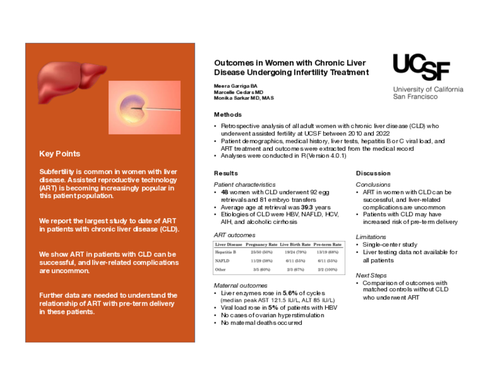
Introduction: Women with cirrhosis commonly have amenorrhea and subfertility, although the safety and effectiveness of assisted reproductive technology (ART) across the range of chronic liver disease is not well understood, making pre-conception counseling complex. Here, we report the largest study to date of ART in patients with chronic liver disease.
Aims: 1. To evaluate ART outcomes (implantation, live birth, prematurity) in patients with chronic liver disease. 2. To assess the rate of liver-related complications (OHSS, liver enzyme derangements, decompensation of cirrhosis) in patients with chronic liver disease undergoing IVF.
Methods: We conducted a retrospective analysis of all women ages 18-46 with chronic liver disease (CLD) determined from chart review who underwent ART treatment at our center between 2010 and 2022 (n=48). Patient demographics, medical history, liver tests, hepatitis B or C viral load, and ART treatment and outcomes were extracted from the electronic health record. Outcomes of interest included implantation rate, birth rate, change in liver enzymes or viral load (the latter for patients with chronic hepatitis B [CHB] or hepatitis C [HCV]), and other pregnancy complications. Analyses were conducted in R (Version 4.0.1).
Results: We identified 48 women with CLD who underwent 92 oocyte retrievals and 81 oocyte transfers at UCSF between 2010 and 2022. Average age at retrieval was 39.3 years (SD 3.4 years) and at transfer was 39.9 years (SD 3.5 years). Etiologies of CLD included CHB (56%) and NAFLD (33%), and the remaining 11% included HCV, autoimmune hepatitis, primary biliary cholangitis, and alcoholic cirrhosis (the only cirrhosis case). For women with CHB who underwent oocyte transfer, the implantation rate was 50% (25/50) and live birth rate was 79% (19/24, with one current pregnancy). 68% (13/19) of these deliveries were pre-term, ranging from 24 to 36 weeks, with one neonatal death. For women with NAFLD, the implantation rate was 38% (11/29) and live birth rate was 55% (6/11). All these deliveries were pre-term, ranging from 29 to 36 weeks. For women with other CLD, the implantation rate was 60% (3/5) and live birth rate was 67% (2/3); the two deliveries were pre-term, at 34-35 weeks. Among women with available liver tests, a rise in liver enzymes was observed during 4/73 (5.6%) cycles, occurring in one patient with NAFLD, one patient with PBC, and one patient with CHB (during two separate cycles. The median (IQR) peak AST was 121.5 IU/L (86-157 IU/L) and median (IQR) peak ALT was 85 IU/L (59-185 IU/L). Among 20 women with CHB and available viral load data, only one had a rise in viral load from ~12,000 to 1 million IU/mL; her ALT tripled but remained in normal range. There were no cases of ovarian hyperstimulation syndrome or maternal deaths. 7 patients (3 NAFLD and 4 CHB) developed hypertensive disorders of pregnancy, ranging from gestational hypertension to pre-eclampsia with severe features.
Discussion: ART in women with chronic liver disease can be successful, and liverrelated complications are uncommon. Further data are needed to understand the relationship of ART with pre-term delivery in women with CLD.