145 posters, 12 topics, 25 sessions, 145 authors
ePostersLive by SciGen Technologies S.A. All rights reserved.
UCSF 2023 Inquiry Symposium
10 May | University of San Francisco

P028
Exploring the Feasibility of Cataract Surgery without Routine Monitored Anesthesia Care: Insights from Anesthesiologists
Poster Presenter
Authors
Part of Topic
Clinical & Translational Sciences
Introduction: Cataract surgery is one of the most common elective surgeries among older adults
in the United States. Most of these patients undergo cataract surgery with monitored anesthesia
care (MAC), consisting of one-to-one intraoperative monitoring and sedation administered by an
anesthesiologist or nurse anesthetist. Due to continued advancement of ophthalmologic
techniques, cataract surgery has become a relatively quick, safe, and minimally invasive
procedure in the modern era with low rates of complications and adverse events. In some regions
outside of the United States, cataract surgery is performed with nurse sedation and/or
local/topical anesthetic approaches instead of MAC. Given the safety and efficacy of the
procedure, the projected increase in cataract surgery demand as the U.S. population ages, and the
cost burden to Medicare, stakeholders including policymakers, clinicians, and payers have
questioned the continued routine use of one-to-one MAC for cataract surgery.
Aims: Our aim was to explore anesthesiologist perceptions regarding the possibility and
feasibility of de-implementing routine MAC use for cataract surgery in the U.S.
Methods: This qualitative study consisted of semi-structured virtual interviews with
anesthesiologists (total planned enrollment of 20 anesthesiologists). Purposive sampling via
email was used to select interview candidates. An official interview guide was created utilizing
the Consolidated Framework for Implementation Research. Interviews were recorded on Zoom,
transcribed, and uploaded into Atlas TI, a qualitative data management and analysis program.
The data was analyzed using an inductive thematic analysis approach and the codebook was
refined throughout the interview process to reflect emerging themes. Two independent coders
coded each transcript and any disagreements in coding were resolved by consensus.
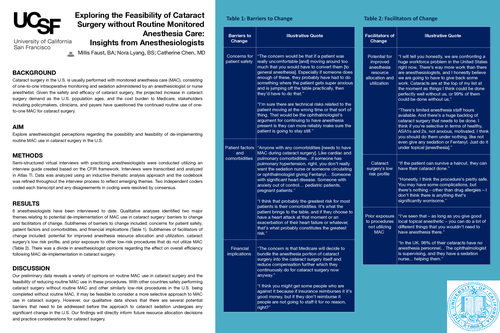
Results: Six anesthesiologists have been interviewed to date. Qualitative analyses of preliminary
data identified two major themes relating to potential de-implementation of MAC use in cataract
surgery: barriers to change and facilitators of change. Subthemes of barriers to change included:
concerns for patient safety, patient factors and comorbidities, and financial implications.
Subthemes of facilitators of change included: potential for improved anesthesia resource
allocation and utilization, cataract surgery’s low risk profile, and prior exposure to other low-risk
procedures that do not utilize MAC. There was a divide in anesthesiologists’ opinions on how
overall efficiency would change following MAC de-implementation in cataract surgery. Some
anesthesiologists felt that MAC de-implementation would lead to more rapid patient turnover
and increased case numbers due to less reliance on anesthesia availability, while others felt that
de-implementation could lengthen the cataract surgery process due to options like oral sedation
having a longer onset of action.
Conclusions: Our preliminary data reveals a variety of opinions on routine MAC use in cataract
surgery and the feasibility of reducing routine MAC use in these procedures. With other
countries safely performing cataract surgery without routine MAC and other similarly low-risk
procedures in the U.S. being completed without routine MAC, it may be feasible to consider a
more selective approach to MAC use in cataract surgery. However, our qualitative data shows
that there are several potential barriers that will need to be addressed before the approach to
cataract sedation undergoes any significant change in the U.S. Our findings will directly inform
future resource allocation decisions and practice considerations for cataract surgery.