145 posters, 12 topics, 25 sessions, 145 authors
ePostersLive by SciGen Technologies S.A. All rights reserved.
UCSF 2023 Inquiry Symposium
10 May | University of San Francisco

P025
Exploring Socioeconomic Disparities in Minimally-Invasive Interventional Radiology Procedures for Pain and Palliation: A 2015 to 2019 Analysis of the National Inpatient Sample
Poster Presenter
Authors
Part of Topic
Clinical & Translational Sciences
Introduction:
Disparities in healthcare are multifactorial in nature. There exists a growing body of literature
aimed at understanding the impact of socioeconomic factors on care and outcomes in the
inpatient setting. Many studies in recent years have attempted to provide a better
understanding of the association between race/ethnicity, gender, insurance status, income
level on the provision of care. Although some of these works have delved into the field of
interventional radiology (IR), there is a paucity of analysis of socioeconomic disparities as they
relate to procedures performed for pain relief and palliation in the inpatient setting.
Aims:
The goal of this project is to provide a quantitative analysis of the socioeconomic factors that
may be associated with a patient’s odds of undergoing interventional radiology procedures for
pain and palliation in the inpatient setting.
Project Design/Methods:
A retrospective analysis of the National Inpatient Sample from 2015 to 2019 was performed.
Using the International Classification of Diseases (ICD)-10 codes, relevant diagnoses for which
minimally-invasive IR interventions are standard were selected. These were: epidural steroid
injection (dx: radiculopathy, sciatica, low back pain), nerve block (dx: cancer pain, pancreatitis,
chronic pelvic pain), cryoablation and arterial embolization (dx: secondary malignant neoplasm
of bone). Patients were grouped according to whether they received the intervention or not
and demographic data regarding age, sex, race, insurance status, income, and hospital location
and teaching status were aggregated. Using SPSS, univariate and multivariate logistic regression
analyses were performed, yielding both unadjusted and adjusted odds ratios (OR). A p-value of
less than 0.05 was used as the threshold for statistical significance.
Results:
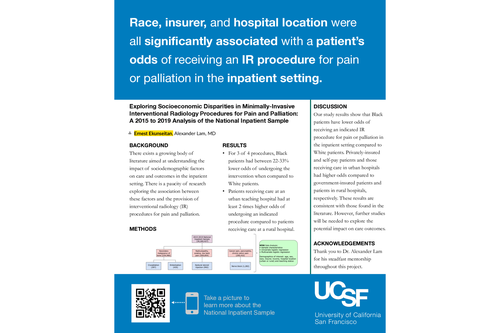
We identified 509,854 patients with a diagnosis of radiculopathy, sciatica, and/or low back pain,
of whom 992 received an epidural steroid injection (ESI). Black patients (unadjusted OR=0.78,
95% CI: 0.63-0.95, p = 0.016) had lower odds of receiving an ESI compared to White patients.
Patients receiving care in urban nonteaching hospitals (unadjusted OR=2.35, 95% CI: 1.71-3.23,
p < .001) and urban teaching (unadjusted OR=2.10, 95% CI: 1.55-2.84, p < .001) hospitals had
higher odds of receiving an ESI compared to patients receiving care in rural hospitals. We
identified 296,432 patients with a diagnosis of cancer pain, pancreatitis, and/or chronic pelvic
pain, of whom 1,282 received a nerve block. Black patients (unadjusted OR=0.78, 95% CI: 0.66-
0.91, p = 0.001) had lower odds of receiving a nerve block compared to White patients.
Privately insured and self-pay patients had higher odds (unadjusted OR=1.27, 95% CI: 1.13-1.43,
p < .001) of receiving a nerve block compared to government-insured patients (Medicare +
Medicaid). Patients receiving care in urban teaching hospitals (unadjusted OR=2.26, 95% CI:
1.68-3.03, p < .001) had higher odds of receiving a nerve block compared to patients receiving
care in rural hospitals. Additionally, we identified 234,486 patients with a diagnosis of
secondary malignancy of bone. Of these, 397 patients received a cryoablation for palliation, and
435 underwent embolization for likely hemorrhage. Privately insured and self-pay patients had
higher odds (unadjusted OR=1.30, 95% CI: 1.05-1.61, p = 0.015) of undergoing cryoablation
compared to government-insured patients. Patients receiving care in urban teaching hospitals
(unadjusted OR=2.67, 95% CI: 1.46-4.87, p = 0.001) had higher odds of undergoing cryoablation
compared to patients receiving care in rural hospitals. Additionally, Black patients (unadjusted
OR=0.67, 95% CI: 0.49-0.92, p = 0.014) had lower odds of undergoing embolization compared to
White patients. Privately insured and self-pay patients had higher odds (unadjusted OR=1.46,
95% CI: 1.20-1.78, p < .001) of undergoing embolization compared to government-insured
patients.
Discussion/Conclusion:
There are discernable patterns that emerge from the results of our study. In general, Black
patients had lower odds of receiving indicated IR procedures for the relevant diagnoses
compared to White patients. Privately-insured and self-pay patients had higher odds of
undergoing the interventions compared to government-insured patients. Similarly, patients
receiving care in urban hospitals had higher odds of undergoing interventions compared to
those receiving care in a rural hospital. Overall, our results suggest that specific demographic
factors, notably race, insurance status, and rural or urban hospital location, are significantly
associated with a patient’s odds of receiving a minimally-invasive IR procedure for pain or
palliation in the inpatient setting. These results are consistent with many of those found in the
literature, including a 2020 study which revealed that White patients received spinal
augmentation for osteoporotic vertebral fractures at higher rates when compared to Black
patients. While various reasons for these associations including but not limited to physician
bias, patient preferences, and/or underresourced hospitals, may be at play, their downstream
effects on care outcomes are yet to be determined. Additional studies will be needed to better
understand the impact of these factors and suggest potential changes that may improve care
for all patients.