145 posters, 12 topics, 25 sessions, 145 authors
ePostersLive by SciGen Technologies S.A. All rights reserved.
UCSF 2023 Inquiry Symposium
10 May | University of San Francisco

P023
Mapping children by ALT 4-5 years after liver transplant: Potential individual and population applications
Poster Presenter
Authors
Part of Topic
Clinical & Translational Sciences
Introduction: On a daily basis, pediatric liver transplant (LT) providers review medical and laboratory data
to determine whether changes in management, most frequently changes in immunosuppression dosing,
are required. While each set of results drives clinical decision-making, it does not provide insight into
either the individual’s longer-term trajectory or the population’s health. Given recent evidence that ALT
gradations across the normal range may reflect allograft health, understanding the distribution of ALT for
children with LTs may facilitate personalized decision-making and/or comparisons of populations among
centers.
Hypothesis: We hypothesized that a single, holistic ALT metric representative of the 5th year after LT would
be able to risk-stratify individuals and populations of children with LTs for future clinical outcomes. We
specifically hypothesized that a single ALT value in the 5th year would poorly represent well-being given
the variability of ALT over time, and that mean ALT would be biased by periods of increased surveillance.
Aims:
- Characterize pediatric LT recipients in the 5th post-LT year by an integrated ALT metric.
- Stratify children with LTs by Year 4-5 ALT and identify associations between stratum assignment
and future clinical outcomes.
Methods: Adjusted mean ALT for the 5th post-transplant year (Yr 4-5) was calculated for children
transplanted 2005-2016 using the median ALT of each month and compared with the first, last, and an
unadjusted mean Yr 4-5 ALT. Adjusted mean Yr 4-5 ALT quartiles (Q1-Q4) were compared using clinical
variables, Yr 5-8 outcomes, and tacrolimus standard deviation (MLVI). Categorical variables were
compared among quartiles using Chi-squared tests and Fisher’s exact test and continuous variables were
compared using Mann Whitney U tests.
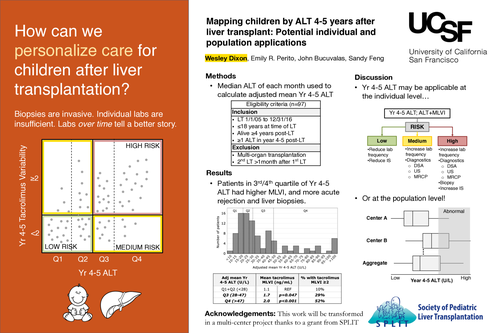
Results: For 97 children [49 male; 77 deceased donors; median (IQR) age at LT of 2.5 (0.8-11.7) years], the
25th, 50th, and 75th percentiles for adjusted mean Yr 4-5 ALT were 19, 28, and 47 U/L, respectively. Adjusted
mean Yr 4-5 ALT and the first Yr 4-5 ALT (r=0.75; p<0.001) and last Yr 4-5 ALT (r=0.65; p<0.001) correlated
moderately. While adjusted mean and mean Yr 4-5 ALT strongly correlated (r=0.95; p<0.001), adjusted
mean values were often lower than the mean values, particularly at upper end of the ALT distribution.
Sex, donor type, LT indication, retransplant within 30 days, rejection history, and mean tacrolimus levels
did not differ between quartiles (Q). Children in Q4 had more Yr 4-5 ALT values (p<0.001), acute rejection
episodes (p=0.0098), Yr 5-8 for-cause liver biopsies (p<0.001), and higher MLVI (p<0.001) than those in
Q1+Q2. Children in Q3 also had more ALT values (p=0.033) and higher MLVI than Q1+Q2 (p=0.047).
Conclusion: We derived a holistic ALT metric, the adjusted mean ALT, that can describe a population of
LT recipients and locate individuals within that cohort. Its association with clinical outcomes and
tacrolimus MLVI suggests biological validity and clinical utility.