145 posters, 12 topics, 25 sessions, 145 authors
ePostersLive by SciGen Technologies S.A. All rights reserved.
UCSF 2023 Inquiry Symposium
10 May | University of San Francisco

P017
Extended Inpatient Monitoring for Sustained Tolerance to Oral Steroid Therapy in Acute Severe Ulcerative Colitis May Be Unnecessarily Prolonging Length of Stay
Poster Presenter
Authors
Part of Topic
Clinical & Translational Sciences
ABSTRACT
Introduction:
Acute severe ulcerative colitis (ASUC) is a potentially life-threatening emergency that almost always
requires inpatient management. A standard care pathway includes early initiation of scheduled
intravenous corticosteroids upon admission. If deemed responsive to treatment, patients are eventually
transitioned to oral steroids which they will continue to take as an outpatient. There is no clear guideline
on whether these patients should remain in the hospital following the transition from intravenous to oral
steroids to be monitored for any worsening of symptoms that would warrant re-escalation of therapy. Our
main objectives were thus two fold: 1) compare rates of oral steroid transition failure and readmission
between ASUC hospitalizations where extended inpatient monitoring was implemented vs where it was
not implemented 2) identify predictors of oral steroid transition failure such that extended inpatient
monitoring may be selectively, rather than universally, implemented.
Methods:
We conducted a retrospective chart review of all ulcerative colitis (UC) related admissions at the
University of California, San Francisco from 2014 – 2022. All adult patients with the primary diagnosis
of UC receiving scheduled intravenous corticosteroids were included. Patients who did not transition to
oral corticosteroids during the hospitalization or on discharge were excluded. Patients who received
colectomy during the hospitalization were only included if the surgery was pursued after a failed trial of
oral corticosteroids that followed a course of scheduled intravenous corticosteroids. Univariable analyses
were performed to identify factors associated with oral steroid transition failure. Multivariable logistic
regression analysis was then performed on variables that were significant on univariable analysis and
those that the authors felt had a high likelihood of being confounders. Data were analyzed using STATA
v16.1.
Results:
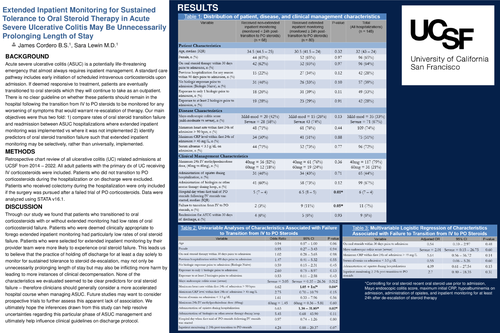
273 UC-related admissions were reviewed. 148 admissions met inclusion criteria. 80 (54%) received
extended inpatient monitoring (monitored ≥ 24h post-transition to oral corticosteroids) while 68 (46%)
underwent accelerated steroid transition or non-extended monitoring (monitored < 24h post-transition to
oral corticosteroids). 9 cases in the former group and 2 cases in the latter group experienced transition
failure, ie clinical decompensation that warranted re-escalation of therapy. Patients who received
extended inpatient monitoring were more likely to exhibit transition failure compared to those who
underwent accelerated steroid transition (11% vs 3%, p = 0.05). None of the 26 cases that proceeded
directly from intravenous corticosteroids to discharge, without an inpatient trial of oral corticosteroids
resulted in readmission for ASUC within 30 days. There was no significant difference in rate of
readmission for ASUC within 30 days in the extended monitoring group compared to the non-extended
monitoring group. Initial univariable logistic regression analyses suggested that maximum heart rate > 90
bpm within the first 24h of admission and the administration of opiates were associated with transition
failure, however none of the examined factors appeared associated with transition failure on multivariable
logistic regression.
Discussion:
Through our retrospective cohort study, we found that patients who transitioned to oral corticosteroids
with or without extended monitoring had low rates of oral corticosteroid failure. Patients who were
deemed clinically appropriate to forego extended inpatient monitoring had particularly low rates of oral
steroid failure. Patients who were selected for extended inpatient monitoring by their provider team were
more likely to experience oral steroid failure. This leads us to believe that the practice of holding off
discharge for at least a day solely to monitor for sustained tolerance to steroid de-escalation, may not only
be unnecessarily prolonging length of stay but may also be inflicting more harm by leading to more
instances of clinical decompensation. None of the characteristics we evaluated seemed to be clear
predictors for oral steroid failure – therefore clinicians should generally consider a more accelerated
hospital course when managing ASUC. Future studies may want to consider prospective trials to further
assess this apparent lack of association. We ultimately hope the inferences drawn from this study can help
resolve uncertainties regarding this particular phase of ASUC management and ultimately help influence
clinical guidelines on discharge protocol.