145 posters, 12 topics, 25 sessions, 145 authors
ePostersLive by SciGen Technologies S.A. All rights reserved.
UCSF 2023 Inquiry Symposium
10 May | University of San Francisco

P015
Limited English Proficiency and Post-operative Outcomes after Cesarean Delivery
Poster Presenter
Authors
Part of Topic
Clinical & Translational Sciences
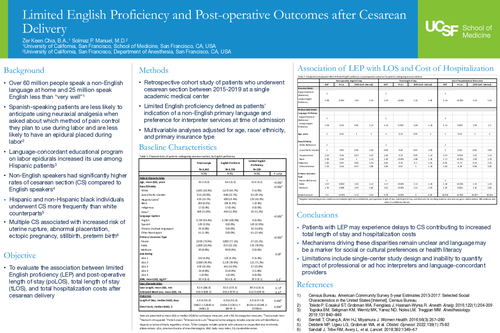
Title: Limited English Proficiency and Post-operative Outcomes After Cesarean Delivery
Introduction: Rates of cesarean delivery have rapidly increased since 1996 to a peak of 32% in
the United States and 21% worldwide. This increase has been attributed to increases in primary
cesarean delivery due to non-reassuring fetal status, but non-clinical factors such as maternal
race, ethnicity, insurance status, and language preference have been associated with differences
in rates of cesarean delivery as well. Other studies have found LEP to be associated with
disparities in outcomes across various settings including prolonged length of stay and increased
hospitalization costs for surgical and medical admissions. In this study we sought to investigate
the association between limited English proficiency (LEP) and post-operative length of stay
(poLOS), total length of stay (tLOS), and total hospitalization costs after cesarean delivery.
Aims: To evaluate the association between limited English proficiency (LEP) and post-operative
length of stay (poLOS), total length of stay (tLOS), and total hospitalization costs after cesarean
delivery.
Methods: This was a retrospective cohort study using electronic health record data of all patients
who underwent cesarean delivery between 2015-2019 at an academic medical center in San
Francisco, CA. The primary predictor was LEP, defined as non-English language preference.
The primary endpoints were poLOS, tLOS, and total hospitalization costs. Descriptive statistics
were used to summarize demographic and clinical characteristics. Differences between English
proficient (EP) and LEP patients were evaluated using 2-sided χ2
, Fisher exact, Wilcoxon ranksum, and t tests as appropriate. Given overdispersion demonstrated by count variables, negative
binomial regression was used to evaluate LEP vs EP patients’ poLOS, tLOS, and total
hospitalization costs adjusted for covariates selected a priori. The significance level was set at
P < .05.
Results: A total of 3,962 patients were included in this study, of which 5.6% had LEP. The most
common non-English languages spoken were Spanish or a Chinese language. In univariate
analysis, patients with LEP had prolonged tLOS and total hospitalization costs associated with
admission for cesarean delivery. After adjusting for covariates in multivariable models, the
association between LEP and tLOS and total hospitalization costs remained significant. There
was no difference in poLOS by language proficiency status.
Conclusions: This study found LEP to be significantly associated with prolonged tLOS and
increased hospitalization costs, but not with prolonged poLOS, after admission for cesarean
delivery. This suggests that LEP patients may experience delays prior to cesarean delivery that
contribute to higher overall healthcare resource utilization. The exact causal mechanism between
LEP and tLOS and hospitalization costs remains unclear, but this finding warrants additional
study to identify how communication barriers, bias, preferences may mediate this finding.
Improved understanding is paramount to delivering equitable care to our diverse patient
population while decreasing costs to our healthcare system.