145 posters, 12 topics, 25 sessions, 145 authors
ePostersLive by SciGen Technologies S.A. All rights reserved.
UCSF 2023 Inquiry Symposium
10 May | University of San Francisco

P148
Risk of herpes zoster ophthalmicus following COVID-19 vaccination in a large US claims database
Poster Presenter
Authors
Part of Topic
Clinical & Translational
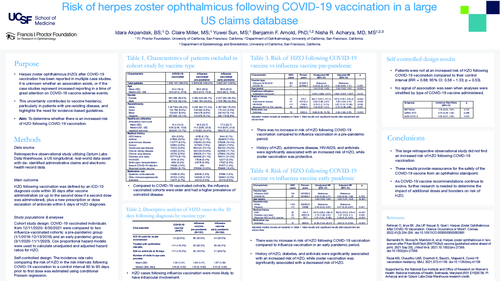
Purpose : To determine whether there is an increased risk of herpes zoster ophthalmicus (HZO) following COVID-19 vaccination.
Methods : Retrospective observational study utilizing OptumLabs® Data Warehouse, a longitudinal, real-world data asset with de- identified administrative claims and electronic health record data. A cohort study design and a self-controlled design were both utilized to investigate HZO following vaccination, defined by an ICD-10 diagnosis code within 30 days after vaccine administration (or up to the second dose if a second dose was administered), plus a new prescription or dose escalation of antivirals within 5 days of HZO diagnosis. Using a cohort design, COVID-19 vaccinated individuals from 12/11/2020- 6/30/2021 were compared to two influenza-vaccinated cohorts: a pre-pandemic group (1/1/2018-12/13/2019) and an early pandemic group (3/1/2020-11/1/2020). Cox proportional hazard models were used to identify unadjusted and adjusted hazard ratios for HZO. Using a self-controlled design, the incidence rate ratio comparing the risk of HZO in the risk intervals following COVID-19 vaccination to a control interval 60 to 90 days prior to the first dose was estimated using conditional Poisson regression.
Results : Among 3,567,715 patients in the COVID-19 vaccinated cohort, there were 60 post-vaccine HZO cases. Patients vaccinated against COVID-19 were not at increased risk of HZO compared to pre-pandemic influenza vaccinated patients (N= 5,101,709; HR= 0.84; 95% CI: 0.61 – 1.16; p= 0.29) and early pandemic influenza vaccinated patients (N= 4,060,412; HR= 0.93; 95% CI: 0.64 – 1.34; p= 0.69) after adjustment for demographics, comorbidities, zoster vaccine, and medication use. Additionally, HZO cases post-COVID-19 vaccination were less likely to be prescribed ophthalmic steroids compared to cases following pre-pandemic and early pandemic influenza vaccination (18.3% vs 29.6% vs 41.4%, respectively). In the self-controlled design, patients were not at increased risk of HZO after COVID-19 vaccination compared to their control interval (IRR= 0.74; 95% CI: 0.49 – 1.12; p= 0.15).
Conclusions : There is not an increased risk of HZO following COVID-19 vaccination. These results provide reassurance for the safety of the COVID-19 vaccine from an ophthalmic standpoint.