145 posters, 12 topics, 25 sessions, 145 authors
ePostersLive by SciGen Technologies S.A. All rights reserved.
UCSF 2023 Inquiry Symposium
10 May | University of San Francisco

P145
Flourishing and Mindfulness in Surgery: Differences by Race and Gender in a Multicenter Study
Poster Presenter
Authors
Part of Topic
Education Science
Introduction & Aims
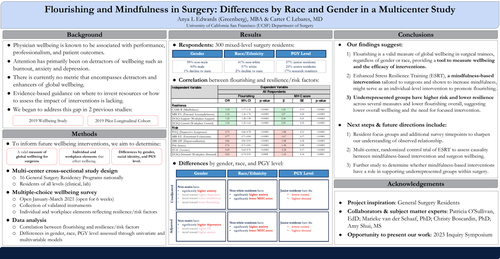
Physician wellbeing has profound personal, clinical, and economic impact. Flourishing (as measured by the Mental Health Continuum, MHC) has been suggested as a concise measure of global wellbeing in surgeons. We hypothesized that it would be a valid measure in surgical trainees. We aimed to establish validity evidence in a large national sample of surgical trainees and explore differences by gender and race.
Project Design
A questionnaire was administered to General Surgery residents at 16 ACGME-accredited programs. The MHC was used to measure flourishing, an established metric of psychosocial thriving in non-physicians. Correlation between flourishing and validated measures of resilience (mindfulness, personal accomplishment, workplace support, workplace control) and risk (depression, burnout, stress, anxiety, workplace demand) were assessed using linear and logistic regression, exploring differences by gender and race.
Results
300 residents (60% non-male, 41% non-white) responded. Overall, flourishing was significantly positively correlated with all resilience factors (including mindfulness) and negatively correlated with all risk factors. Based on interaction analyses, the direction of associations within the gender and race subgroups were identical to the overall sample. Compared to their male counterparts, non-male respondents had significantly higher anxiety (p=0.02) and a trend toward lower flourishing (p=0.07), lower mindfulness (p=0.06), and more depressive symptoms (p=0.06). Compared to their white counterparts, non-white respondents had significantly lower MHC scores (p=0.05) and higher anxiety (p=0.05). Compared to all other self-designated race categories, white and Asian respondents had significantly higher depersonalization scores (p=0.05).
Discussion
Our results support concurrent validity of flourishing as a measure of global wellbeing in surgical trainees, regardless of gender or race. Thus, MHC may be a tool for assaying wellbeing and identifying sub-group differences. Our findings suggest that Enhanced Stress Resilience Training, a mindfulness-based intervention tailored to surgeons and shown to increase mindfulness, might serve as an individual-level intervention to promote flourishing. Underrepresented groups have higher risk and lower resilience across several measures and lower flourishing overall, suggesting lower overall wellbeing and the need for focused intervention.
Table 1. Scores by Gender and Race Categories
|
|
Gender |
Race |
||||
|
Male |
Non-Male1 |
p-value |
White |
Non-White2 |
p-value |
|
|
Wellbeing |
|
|
|
|
|
|
|
MHC total score, mean (SD) |
47.53 (13.20) |
45.01 (13.15) |
0.11 |
47.56 (13.31) |
44.54 (12.49) |
0.05 |
|
Flourishing, n (%) |
71 (60.2%) |
85 (48.9%) |
0.07 |
96 (57.5%) |
60 (50.0%) |
0.23 |
|
Resilience |
|
|
|
|
|
|
|
CAMS-R, mean (SD) |
28.64 (5.01) |
27.41 (5.22) |
0.06 |
28.37 (4.76) |
27.44 (5.66) |
0.17 |
|
MBI-PA, mean (SD) |
13.98 (2.80) |
13.75 (2.60) |
0.50 |
13.90 (2.62) |
13.76 (2.80) |
0.69 |
|
DCSQ-Support, mean (SD) |
19.03 (3.26) |
19.39 (3.01) |
0.34 |
19.40 (3.08) |
19.03 (3.19) |
0.33 |
|
DCSQ-Control, mean (SD) |
13.60 (2.36) |
13.83 (2.00) |
0.40 |
13.79 (2.06) |
13.64 (2.31) |
0.58 |
|
Risk |
|
|
|
|
|
|
|
PHQ, mean (SD) |
5.92 (4.88) |
7.08 (4.92) |
0.06 |
6.44 (5.01) |
6.43 (4.43) |
>0.99 |
|
MBI-EE, mean (SD) |
9.43 (4.15) |
10.28 (4.08) |
0.10 |
9.90 (3.94) |
9.75 (4.26) |
0.78 |
|
MBI-DP, mean (SD) |
6.91 (4.47) |
6.72 (4.18) |
0.73 |
7.01 (4.21) |
6.40 (4.36) |
0.26 |
|
PSS, mean (SD) |
16.78 (6.27) |
18.07 (6.11) |
0.10 |
17.41 (6.50) |
17.57 (5.77) |
0.84 |
|
STAI, mean (SD) |
11.96 (3.62) |
13.02 (3.57) |
0.02 |
12.16 (3.51) |
13.06 (3.69) |
0.05 |
|
DCSQ-Demand, mean (SD) |
15.56 (2.31) |
15.68 (2.27) |
0.67 |
15.67 (2.17) |
15.55 (2.45) |
0.66 |
1Non-Male includes Female and Gender non-binary
2Non-White includes American Indian or Alaska Native, Asia, Black or African American, Latinx, Native Hawaiian or Other Pacific Islander, and mixed race
MHC = Mental Health Continuum; CAMS-R = Cognitive and Affective Mindfulness Scale-Revised; MBI-PA = Maslach Burnout Inventory-Personal Accomplishment; DCSQ-Support = Demand, Control, Support Questionnaire-Support; DCSQ-Control = Demand, Control, Support Questionnaire-Control. For these scales, higher score is better.
PHQ = Patient Health questionnaire; MBI-EE = Maslach Burnout Inventory-Emotional Exhaustion; MBI-DP = Maslach Burnout Inventory-Depersonalization; PSS = Perceived Stress Scale; STAI = State-Trait Anxiety Index; DCSQ-Demand = Demand, Control, Support Questionnaire-Demand; SD = Standard Deviation. For these scales, lower score is better.