145 posters, 12 topics, 25 sessions, 145 authors
ePostersLive by SciGen Technologies S.A. All rights reserved.
UCSF 2023 Inquiry Symposium
10 May | University of San Francisco

P140
Analysis of Patients with Juvenile Dermatomyositis Compared to Healthy Controls Using CITE-seq Identifies Differences in Cell Composition and Gene and Epitope Expression
Poster Presenter
Authors
Part of Topic
Clinical & Translational
Introduction: Juvenile dermatomyositis (JDM) is a rare and serious systemic autoimmune condition, and much remains unknown about the pathogenesis of and the immune cell types and cell-specific pathways associated with disease. Increasing knowledge of immune dysregulation in JDM with detailed immunophenotyping at the cellular level could lead to identification of new therapeutic targets and insight into disease mechanisms.
Hypothesis/Aims: We hypothesize that
- Patients with JDM will show differences in immune cell composition.
- Patients with JDM will show distinct transcriptomic and proteomic differences.
- Selected differences which correlate to disease activity measures
And thus, aim to determine cell composition and transcriptomic and proteomic profiles and correlate these to disease activity measures.
Project design: Multiplexed single cell RNA and protein sequencing was applied to 27 peripheral blood samples to simultaneously profile the gene expression and cell surface antibody (ADT) signatures associated with JDM (n=15, samples=22) compared to healthy pediatric controls (HC)(n=5). Demuxlet was used to remove doublets and assign cells to individuals. Data processing steps were performed using SoupX, Harmony, DSB, and Seurat and included quality control, dimensional reduction, clustering, and cell type annotation using canonical ADT and gene markers. To determine changes associated with JDM, we performed: 1) cell type proportion analysis between individual groups (treatment naïve (TN), inactive, HC) and overall 2) correlation analysis between cell type proportion and disease activity measures for all JDM samples, 3) differential gene expression between TN JDM and HC and inactive JDM and HC for each cell type using DESeq2 (FDR < 0.05), 4) differential epitope expression between TN JDM and HC for each cell type using DESeq2 (FDR < 0.05),, and finally 5) gene overrepresentation analysis (GOA) with clusterProfiler.
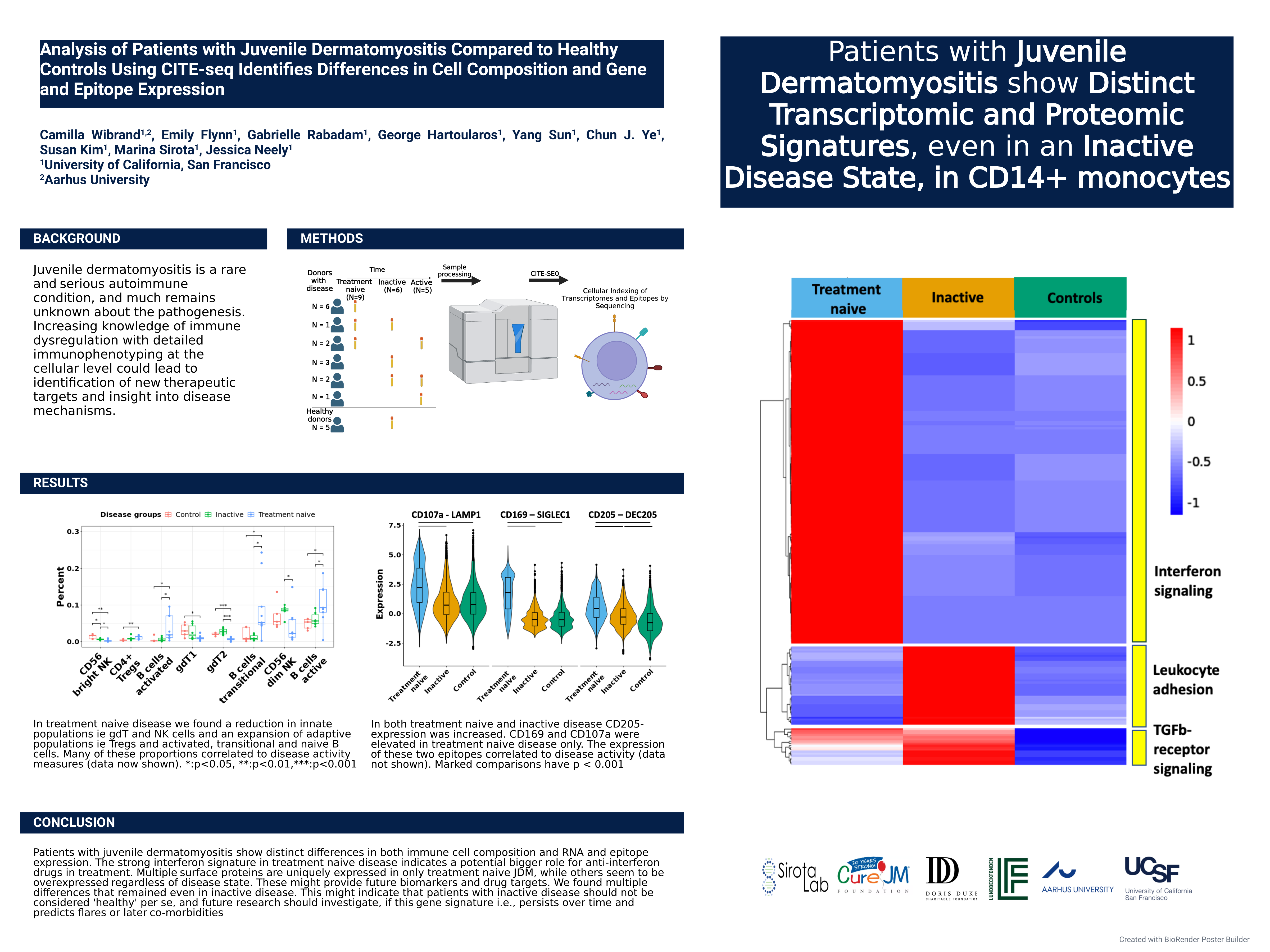
Results: ~110,000 immune cells were analyzed. Using unsupervised clustering, we identified 29 clusters, which compromised 21 unique immune cell populations. TN patients had statistically significantly higher levels of transitional, activated, and naïve B cells compared to inactive JDM and HC, and cell type proportion was positively correlated with measures of disease activity. Patients with inactive disease had higher proportions of effector CD4+ T cells and CD56dim NK cells compared to TN patients, and the proportion of these cell types was negatively correlated with disease activity measures. TN patients had significantly fewer gd T cells than both healthy controls, and cell type proportion was negatively correlated with disease activity measures. Tregs were elevated in JDM irrespective of disease state compared to HC. Most differentially expressed genes were found within CD14+ and CD16+ monocytes and memory B cells. However, many differentially expressed genes shared among cell types, and GOA revealed overrepresentation in genes involved in type 1 interferon and interferon gamma pathways for most cell types. We clustered the genes upregulated in CD14+ monocytes in both TN and inactive disease and found a shared transcriptomic signature between TN and inactive JDM, consisting of genes involved in the TGFb pathway. Differential protein analysis revealed upregulation of SIGLEC-1 and LAMP-1 and downregulation of CD179a on the surface of both CD14+ and CD16+ monocytes in TN JDM. The expression of both SIGLEC-1 and LAMP-1 correlated with disease activity measures. Other proteins, such as CD205, were upregulated in both TN and inactive JDM.
Discussion: We successfully identified that there are alterations in immune cell composition within the B, CD4+ T, gd T, and NK cell compartments in JDM and that many of these are associated with disease activity. Monocytes and memory B cells experience major gene expression changes during disease, but all cell types are heavily influenced by interferon signaling. The strong interferon signature in treatment naive disease indicates a potential bigger role for anti-interferon drugs in treatment. Multiple surface proteins are uniquely expressed in only TN JDM, while others seem to be overexpressed regardless of disease state. These might provide future biomarkers and drug targets.
We found multiple difference in both transcriptomic and proteomic features that remain even in inactive disease states with no medication. This might indicate that patients with inactive disease should not be considered 'healthy' per se, and future research should investigate, if this gene signature i.e., persists over time and predicts flares or later co-morbidities.
Although CITE-seq provides a unique insight into proteomic profiles of cells, further validation using i.e., cytometry by time of flight or flow cytometry should be performed. Furthermore, we plan to expand the analysis including network and cell communication analysis to get a greater overview of the difference.