145 posters, 12 topics, 25 sessions, 145 authors
ePostersLive by SciGen Technologies S.A. All rights reserved.
UCSF 2023 Inquiry Symposium
10 May | University of San Francisco

P133
Acrylated Hyaluronic-Acid Based Hydrogel for the Treatment of Craniofacial Volumetric Muscle Loss
Poster Presenter
Authors
Part of Topic
Clinical & Translational
Introduction
Current treatment options for craniofacial volumetric muscle loss (VML) have disadvantages and are unable to fully restore normal function. While in vivo studies of tissue engineering strategies in animal models of extremity VML have shown promise, very little research in craniofacial VML has been conducted. Hydrogels, such as semi-synthetic hyaluronic acid (HyA) hydrogels, can fill irregularly shaped defects, resemble natural extracellular matrix, and induce a minimal inflammatory response. The present study evaluates the efficacy and biocompatibility of HyA hydrogel in the treatment of craniofacial VML using a novel rodent model of masseter VML.
Hypothesis
We expect to see a reduction in the degree of fibrosis and an increase in de novo muscle regeneration among hydrogel-treated masseters relative to untreated controls.
Aims
The aims of the project include a comparison of the degree of fibrosis, wound contracture, and de novo muscle regeneration between VML-injured masseters treated with different formulations of hydrogel and untreated controls.
Methods
Four rats were included in both the hydrogel and untreated control groups at each timepoint. All animals received a surgically created VML injury that consisted of removal of approximately 10% of the right superficial masseter. Three separate formulations of hydrogel, prepared as cryogels, with varying MMP-sensitive crosslinkers (slow-, medium-, and fast-breakdown) were administered for comparison of primary outcomes. These cryogels were compared to former iterations of the hydrogel, including a freeze-dried scaffold formulation (OFD) and liquid hydrogel. Masseters were explanted between 2- and 16-weeks postoperatively and cryosectioned. Tissue sections were stained with Hematoxylin and Eosin (H&E) to assess defect size and measure fiber-cross sectional area (FCSA) and with Masson’s trichrome to assess collagen deposition. Images were captured 10x using light microscopy and histological parameters were measured using Image J software. Quantitative data was analyzed using one- or two-way analysis of variance (ANOVA) with intervention (e.g. hydrogel or no treatment) and time post-repair as the independent variables and histological measures as dependent variables.
Results
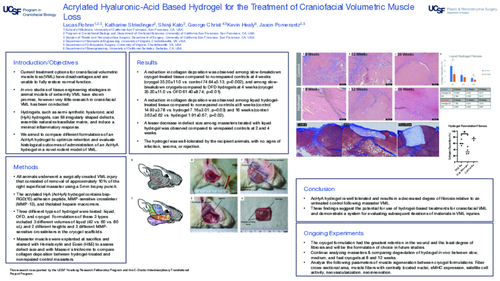
The cryogels were retained in 100% of injuries, and a reduction in collagen deposition was observed among slow-breakdown cryogel-treated tissue compared to nonrepaired controls at 4 weeks (cryogel 35.20±11.0 vs. control 74.64±5.13; p=0.002), and among slow-breakdown cryogels compared to OFD hydrogels at 4 weeks (cryogel 35.20±11.0 vs. OFD 61.40±8.74; p=0.01). A reduction in collagen deposition was observed among liquid hydrogel-treated tissue compared to nonrepaired controls at 8 weeks (control 14.93±3.78 vs. hydrogel 7.16±3.01; p=0.03) and 16 weeks (control 3.62±0.62 vs. hydrogel 1.91±0.67; p=0.02). A lesser decrease in defect size among masseters treated with liquid hydrogel was observed compared to unrepaired controls at 2 and 4 weeks. The hydrogel was well-tolerated by the recipient animals, with no signs of infection, seroma, or rejection.
Discussion
This study represents an early step in the use of a semisynthetic hydrogel to promote muscle regeneration in a craniofacial rodent model of VML. The results of this study demonstrate that AcHyA hydrogel is well tolerated and suggests hydrogel mitigates the fibrotic healing response and wound contracture in the masseter following VML. These findings are in line with previous studies evaluating this hydrogel formulation in a rodent model of tibialis anterior VML. These findings suggest the potential for use of hydrogel-based treatments for craniofacial VML and demonstrate a system for evaluating subsequent iterations of materials in craniofacial VML injuries. The use of rodents for craniofacial VML models has limitations. Whether a true critical defect has been established is unclear and compensatory influence of synergistic muscles and contralateral uninjured muscles make force testing difficult. The cryogel formulation had the greatest retention in the wound and the least degree of fibrosis and will be the formulation of choice in future studies. Future studies will assess histological measurements to corroborate known cellular markers of regeneration with morphological parameters discussed here as well as measurements of de novo neovascularization and innervation. Further studies will also aim to elucidate whether this VML model reaches a critical degree rendering endogenous regeneration ineffective through in vivo functional assays and immunohistochemical characterization of the regenerative niche. The MMP-sensitive crosslinker of choice will be selected based on future analyses of muscle regeneration including fiber cross-sectional area, number of muscle fibers with centrally located nuclei, embryonic myosin heavy-chain expression, satellite cell activity, neovascularization, and neoinnervation.