145 posters, 12 topics, 25 sessions, 145 authors
ePostersLive by SciGen Technologies S.A. All rights reserved.
UCSF 2023 Inquiry Symposium
10 May | University of San Francisco

P131
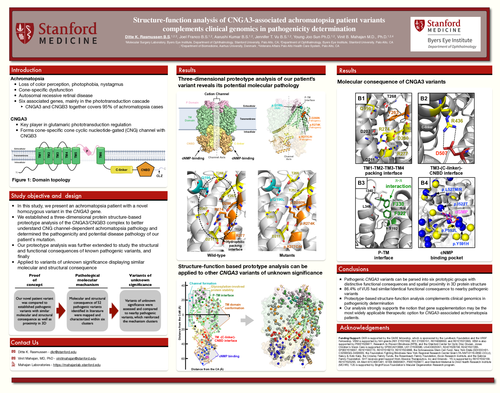
Structure-function analysis of CNGA3-associated achromatopsia patient variants complements clinical genomics in pathogenicity determination
Poster Presenter
Authors
Part of Topic
Clinical & Translational
Introduction: Achromatopsia is an autosomal recessive genetic disease with six associated genes, five of which play vital roles in the cone phototransduction cascade. Up to 95% of achromatopsia patients carry pathogenic mutations in the CNGA3 and/or CNGB3 gene(s), two of the five genes from the aforementioned cascade. Once translated, these genes function together by forming a cone CNG channel protein complex. Fifty-two pathogenic variants in CNGA3 have been identified through clinical genomics, but the pathogenicity of more than one hundred CNGA3 variants in achromatopsia patients remains unknown due to inconclusive genetic information. This results in a group of patients without access to proper diagnosis and genetic counseling, which further obstructs appropriate clinical follow-up and enrollment in gene therapy trials.
Hypothesis and aims: In this study, we set out to create a structure-function based proteotype analysis tool to determine pathogenicity of CNGA3 variants associated with achromatopsia.
Methods: This retrospective meta-analysis utilized the cryo-EM based structure model of the cone CNG-channel complex to map CNGA3 variants associated with achromatopsia. We performed proteotype analysis of established pathogenic variants and identified six proteotypic groups with distinctive functional consequences and spatial proximity in the CNGA3 three-dimensional protein structure. This meta-analysis was further applied to 103 variants of unknown significance with clear clinical association with achromatopsia.
Results: Strikingly, 86.4% of VUS had similar/identical functional consequences to nearby pathogenic variants, which suggests their potential molecular pathology and pathogenicity.
Discussion: These results demonstrate that proteotype-based analysis can be a valuable approach for assessing pathogenicity and providing mechanistic insight into the molecular pathology of patient variants such that it may be utilized in complement with clinical genomics.