145 posters, 12 topics, 25 sessions, 145 authors
ePostersLive by SciGen Technologies S.A. All rights reserved.
UCSF 2023 Inquiry Symposium
10 May | University of San Francisco

P129
Steroid Avoidance After Adult Living Donor Liver Transplant – A cohort analysis
Poster Presenter
Authors
Part of Topic
Clinical & Translational
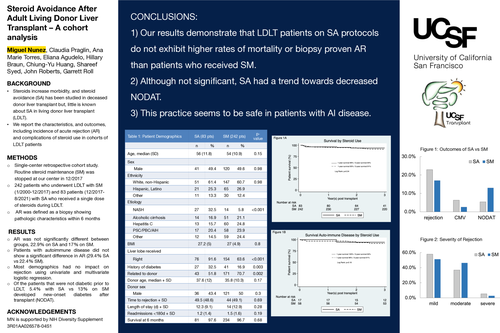
Background: While steroid avoidance (SA) has been studied in deceased donor liver transplant,
little is known about SA in living donor liver transplant (LDLT). We report the characteristics and
outcomes, including the incidence of early acute rejection (AR) and complications of steroid use,
in two cohorts of LDLT recipients.
Methods: Routine steroid maintenance (SM) after LDLT was stopped in 12/2017. Our singlecenter retrospective cohort study spans two eras. 242 adult recipients underwent LDLT with SM
(1/2000-12/2017) and 83 adult recipients (12/2017-8/2021) underwent LDLT with SA. Early AR
was defined as a biopsy showing pathologic characteristics within six months after LDLT.
Univariate and multivariate logistic regressions were performed to evaluate the effects of relevant
recipient and donor characteristics on the incidence of early AR in our cohort.
Results: Neither the difference in early AR rate between cohorts (SA 19/83 [22.9%] vs SM 41/242
[17%]; p=0.46), nor a subset analysis of patients with autoimmune disease (AI) (SA 5/17 [29.4%]
vs SM 19/58 [22.4%]; p=0.71) reached statistical significance. Univariate and multivariate logistic
regression for early AR identified recipient age to be a statistically significant risk factor
(p<0.001). Of the patients without diabetes before LDLT, 3/56 (5.4%) on SA versus 26/200 (13%)
on SM needed medications prescribed for glucose control at the time of discharge (p=0.11). Patient
survival was similar between SA and SM cohorts (SA 94% vs SM 91%, p=0.34) three years after
transplant.
Conclusions: LDLT recipients treated with SA do not exhibit significantly higher rates of rejection
or increased mortality than patients treated with SM. Notably, this result is similar for recipients
with AI disease