145 posters, 12 topics, 25 sessions, 145 authors
ePostersLive by SciGen Technologies S.A. All rights reserved.
UCSF 2023 Inquiry Symposium
10 May | University of San Francisco

P121
Ambulatory Urine Biomarker Associations with AKI and Hospitalization in HIV-Infected Men and Women: Predictors of Acute Kidney Injury Study (PARIS)
Part of Topic
Clinical & Translational
Background:
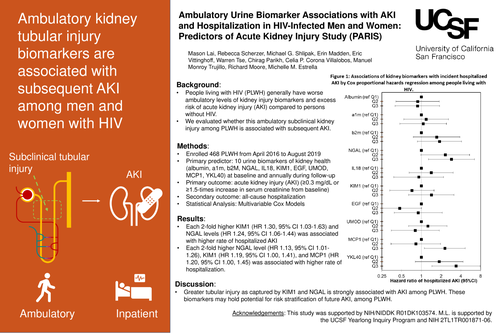
People living with HIV (PLWH) generally have worse ambulatory levels of kidney injury biomarkers and excess risk of acute kidney injury (AKI) compared to persons without HIV. We evaluated whether this ambulatory subclinical kidney injury among PLWH is associated with subsequent AKI.
Methods:
In the Predictors of Acute Renal Injury Study (PARIS) which enrolled 468 PLWH from April 2016 to August 2019, we measured 10 urine biomarkers of kidney health (albumin, a1m, b2M, NGAL, IL18, KIM1, EGF, UMOD, MCP1, YKL40) at baseline and annually during follow-up. Using multivariable Cox regression models, we evaluated baseline and time-updated biomarker associations with the primary outcome of AKI (≥0.3 mg/dL or ≥1.5-times increase in serum creatinine from baseline) and secondary outcome of all-cause hospitalization.
Results:
At baseline, the mean age was 53 years old and 45% self-identified as female. In time-updated models adjusting for sociodemographic factors, comorbidities, albuminuria, eGFR, and HIV-associated factors, each 2-fold higher KIM1 (HR 1.30, 95% CI 1.03-1.63) and NGAL level (HR 1.24, 95% CI 1.06-1.44) was associated with higher risk of hospitalized AKI. Additionally, in multivariable, time-updated models, each 2-fold higher NGAL level (HR 1.13, 95% CI 1.01-1.26), KIM1 (HR 1.19, 95% CI 1.00, 1.41), and MCP1 (HR 1.20, 95% CI 1.00, 1.45) was modestly associated with higher risk of hospitalization.
Conclusions:
Greater tubular injury as captured by KIM1 and NGAL is strongly associated with AKI among PLWH. These biomarkers may hold potential for risk stratification of future AKI, among PLWH.