145 posters, 12 topics, 25 sessions, 145 authors
ePostersLive by SciGen Technologies S.A. All rights reserved.
UCSF 2023 Inquiry Symposium
10 May | University of San Francisco

P119
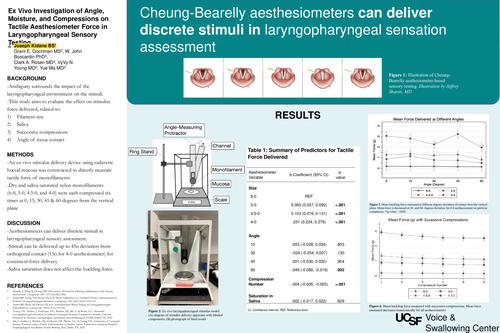
Ex Vivo Investigation of Angle, Moisture, and Compressions on Tactile Aesthesiometer Force in Laryngopharyngeal Sensory Testing
Poster Presenter
Authors
Part of Topic
Clinical & Translational
Introduction: Laryngeal sensory function in healthy adults was assessed through the delivery of tactile stimuli using Cheung-Bearelly monofilaments.
Methods: 37 healthy adults were recruited with 340 tactile stimuli analyzed. Four calibrated tactile stimuli were delivered to three laryngeal sites: false vocal fold (FVF), aryepiglottic fold (AEF), and lateral pyriform sinus (LPS). Primary outcome was the elicitation of laryngeal adductor reflex (LAR). Secondary outcomes were gag, patient-reported laryngeal sensation (PRLS), and perceptual strength. Analysis was performed with mixed effects logistic regression modeling.
Results: Positive LAR was observed in 35.7%, 70.2%, and 91.2% of stimuli at LPS, AEF, and FVF respectively. LAR rates were significantly associated with laryngopharyngeal subsite (p < 0.001), tactile force (p = 0.001), age (p = 0.022) and sex (p = 0.022). LAR, gag, PRLS, and perceptual strength significantly increased as a more medial laryngeal subsite was stimulated and as stimulus force increased. Each of the ten years of age increase was associated with 19% reduction in odds of LAR (aOR = 0.81, 95% CI [0.68, 0.97]; p = 0.022). Male gender was associated with a 55% reduction in odds of LAR (aOR = 0.45, 95% CI [0.23, 0.89]; p = 0.022).
Conclusion: LAR elicitation capability decreases in the male gender, aging, and a more lateral subsite. This study provides insight into the pathophysiology of hypo- and hyper-sensitive laryngeal disorders and is paramount to making accurate diagnostic assessments and finding novel treatment options for various laryngological disorders.