145 posters, 12 topics, 25 sessions, 145 authors
ePostersLive by SciGen Technologies S.A. All rights reserved.
UCSF 2023 Inquiry Symposium
10 May | University of San Francisco

P113
The mitigated carbon emissions of transitioning to virtual medical school and residency interviews: A national, survey-based study
Poster Presenter
Authors
Part of Topic
Education
Title: The mitigated carbon emissions of transitioning to virtual medical school and residency interviews: A national, survey-based study
Introduction: Prior to COVID, thousands of medical school and residency applicants traversed the US for in-person interviews each year. The costs and inefficiencies of in-person medical school, residency, and fellowship interviews, and their equity implications, have been well-characterized. However, though the carbon footprint of over 75,000 annual medical school, residency, and fellowship applicants crisscrossing the country for interviews is presumably sizeable, research quantifying interview-associated greenhouse gas emissions is limited.
Hypothesis/Question: This study estimated greenhouse gas emissions associated with in-person medical school and residency interviews and explored applicant interview structure preferences.
Aims
- Estimate carbon emissions associated with travel for in-person medical school and residency interviews
- Explore applicant priorities and preferences regarding future interview formats
Project Design/Methods: From March to June 2022, we developed and distributed a nine-question, website-based survey to collect information on applicant virtual interview schedule, demographics, and preference for future interview format. We calculated theoretical emissions for all interviews requiring air travel and performed a content analysis of interview preference explanations.
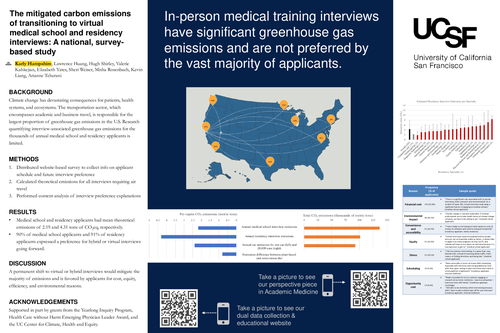
Results/Product: We received responses from 258 first year and 253 fourth year medical students at 26 allopathic US medical schools who interviewed virtually in 2020-2021 and 2021-2022, respectively. Residency applicants interviewed at a mean of 15.3 programs (SD 5.4) and had mean theoretical emissions of 4.31 tons CO2eq. Medical school applicants interviewed at a mean of 6.9 programs and had mean theoretical emissions of 2.19 tons CO2eq. 90% of medical school applicants and 91% of residency applicants expressed a preference for hybrid or virtual interviews going forward.
Discussion/Conclusion: This is the first multi-institution study to estimate emissions of in-person residency interviews, and the first study to estimate emissions of in-person medical school interviews. We find that flights associated with in-person medical school and residency interviews have significant carbon emissions and are not preferred by applicants. Limitations of this study include low response rate, use of virtual interview itineraries as a proxy for in-person interview itineraries, and lack of inclusion of non-air-travel emissions. The COVID-19 pandemic has created the opportunity to reimagine in-person interviews for medical school and residency which are responsible for significant CO2 emissions each year. A permanent shift to virtual or hybrid interviews would mitigate the majority of these emissions and based on our study findings, is favored by applicants for cost, equity, efficiency, and environmental reasons.