145 posters, 12 topics, 25 sessions, 145 authors
ePostersLive by SciGen Technologies S.A. All rights reserved.
UCSF 2023 Inquiry Symposium
10 May | University of San Francisco

P111
Prospective Evaluation of Neck and Shoulder Function Following Treatments of Early-Stage Human Papillomavirus-Associated Oropharynx Cancer
Poster Presenter
Authors
Part of Topic
Clinical & Translational
Introduction: Patients with human papilloma virus (HPV)-associated oropharyngeal squamous cell carcinoma (OPSCC) have better prognoses than their HPV-negative counterparts, but many still experience treatment-related adverse effects based on treatment modality that impact quality of life (QOL). However, while the effects of neck dissection and radiation on shoulder impairment have been independently established, prospective data comparing post-treatment shoulder dysfunction between therapeutic modalities for HPV-positive OPSCC is limited.
Objective: To evaluate impact of treatment modality on short-term shoulder dysfunction following treatment in an early-stage HPV-positive OPSCC cohort.
Methods: Treatment-naïve patients with American Joint Committee on Cancer 8th edition T0-3/N0-2 HPV+OPSCC completed the Neck Dissection Impairment Index (NDII) before, 3-months, and 1-year after treatment. The NDII assesses 10 shoulder and neck functions scored 0-5 (total 0-50); higher scores suggest better function.
Results:
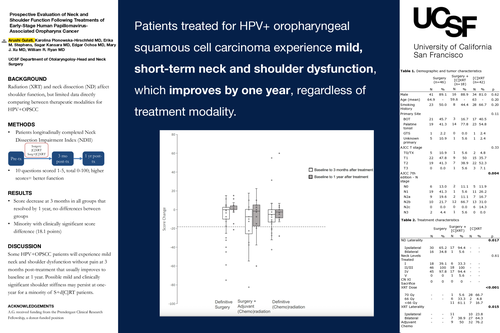
Of 94 patients, 43 (46%) underwent surgery alone (S), 17 (18%) underwent surgery with adjuvant radiation±chemotherapy (S+[C]RT), and 34 (36%) underwent radiation±chemotherapy ([C]RT). cTN stage and pretreatment NDII scores did not differ between groups. Mean post-treatment NDII scores were similar between groups (surgery: 44.3±8.3, S+[C]XRT: 41.9±10.8, d[C]XRT: 46.0±4.3; p=0.29).
Compared to pretreatment, S patients reported worsened 3-month posttreatment self-care (5.0 vs 4.6), lifting light (5.0 vs 4.6) and heavy (4.8 vs 4.2) objects, overhead reach (4.9 vs 4.4), activity (4.9 vs 4.5), recreation (4.9 vs 4.6), and overall score (48.1 vs 44) (all p<0.05). 1-year posttreatment scores (n=27) did not differ from pretreatment in any domain.
Compared to pretreatment, S+[C]RT patients reported worsened 3-month stiffness (4.8 vs 3.9), lifting heavy objects (4.9 vs 3.8), overhead reach (4.9 vs 4.1), socialization (5.0 vs 4.5), and overall score (48.4 vs 42.4) (all p<0.05), but no change from pretreatment by 1 year (n=16).
Overall, [C]RT patients reported no change in any domain after treatment. Bilateral [C]RT patients (n=12) reported worse recreation (p=0.02) and activity (p=0.05) at 3 months, but only difficulty lifting light objects (4.9 vs 4.5, p=0.04) at 1 year.
Conclusions: HPV+OPSCC patients who undergo S, S+[C]RT, or bilateral [C]RT may experience mild shoulder/neck dysfunction 3-months after treatment that usually resolves by 1-year.