145 posters, 12 topics, 25 sessions, 145 authors
ePostersLive by SciGen Technologies S.A. All rights reserved.
UCSF 2023 Inquiry Symposium
10 May | University of San Francisco

P110
Interactive effects of e-cigarette and cannabis use on neural reactivity among adolescent dual-users
Poster Presenter
Authors
Part of Topic
Clinical & Translational
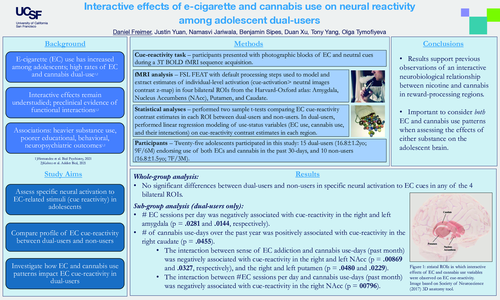
Purpose: To examine whether adolescents who use both e-cigarettes and cannabis (dual-users) display different neural responses to either e-cigarette (EC)- or cannabis-related stimuli compared to non-users.
Methods: A total of 15 adolescent dual-users (16.8±1.2yo; 9F/6M) who endorsed use of both ECs and cannabis in the past 30 days) and 10 non-users (16.8±1.5yo; 7F/3M) were included in this study. Participants were presented with photographic blocks of EC, cannabis, and neutral cues during functional magnetic resonance imaging scanning.
Results: For dual-users, neither EC nor cannabis cues elicited greater specific neural activation than neutral cues in any region. We also found no significant differences between dual-users and non-users in specific neural activation to either e-cigarette or cannabis cues. However, we observed significant relationships between EC use variables, cannabis use variables, and their interaction on specific neural activation in striatal regions (Nucleus Accumbens, Putamen, Caudate) to both EC and cannabis cues among dual-users.
Conclusion: Our findings provide support for previous observations of an interactive neurobiological relationship between nicotine and cannabis in regions associated with reward-processing and development of substance-use disorders, suggesting that both EC and cannabis use patterns may be important to consider when assessing the effects of either single substance on the adolescent brain. The results may enhance understanding of the basic bio-behavioral mechanisms involved in nicotine and cannabis dependence among adolescents, including the identification of neural biomarkers that could facilitate development of substance-cessation treatment strategies and differentiation of cessation treatment responders from non-responders.