145 posters, 12 topics, 25 sessions, 145 authors
ePostersLive by SciGen Technologies S.A. All rights reserved.
UCSF 2023 Inquiry Symposium
10 May | University of San Francisco

P107
Investigating well-being in Surgery Residency using Social Network Analysis
Poster Presenter
Authors
Part of Topic
Education
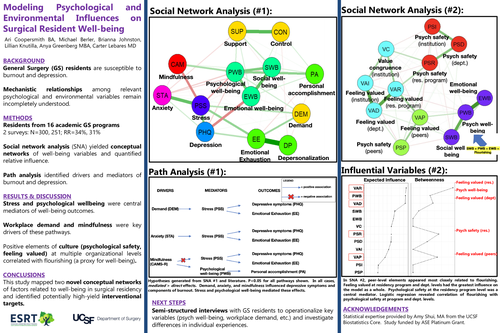
Introduction: Well-being in surgical residency depends on more than work hours. While numerous psychological and environmental variables have been associated with burnout and depression in residency, mechanistic relationships among these factors remain incompletely understood. Furthermore, while the importance of positive cultural elements, such as psychological safety and feeling valued, is widely accepted, questions remain about how these elements influence flourishing (a proxy for well-being) and vary by organizational level (peers, residency program, department, institution).
Methods: We distributed two surveys to General Surgery residents at 16 academic programs in January 2022, both containing well-being metrics. The first survey examined burnout, depression, and related factors (mindfulness; workplace demand, control, and support; stress and anxiety; flourishing) and the second examined flourishing in relation to cultural elements (psychological safety, feeling valued) at multiple organizational levels. We used social network analysis to quantitatively arrange variables into conceptual networks and a Spinglass algorithm to determine “communities” of statistically-related variables.
Results & Discussion: 300 residents responded to the first survey (34% response rate) and 251 residents to the second survey (31% response rate). Analysis of the first survey yielded a conceptual network of well-being features, and subsequent path analysis found that for pathways leading to burnout and depression, workplace demand and mindfulness were important drivers, and psychological well-being (a component of flourishing) and perceived stress were central mediators (p<0.05 for all relationships; and in all cases, mediated effects > direct effects).
In social network analysis of the second survey, peer-related cultural factors appeared most directly related to flourishing. Feeling valued at the residency program and department levels had the highest expected influence scores. Feeling valued and psychological safety at the residency program-level had the highest betweenness (mediation) scores.
Conclusions:
This study mapped two novel conceptual networks of factors related to well-being in surgical residency and identified the variables above as potentially high-yield interventional targets. The results support use of tested interventions that target these variables (e.g., formal mindfulness training; organizational psychological safety interventions). In order to support precision in the design of interventions to promote well-being in residency, next steps include semi-structured interviews with residents to examine how these variables specifically manifest in surgery residency and vary by individual.