145 posters, 12 topics, 25 sessions, 145 authors
ePostersLive by SciGen Technologies S.A. All rights reserved.
UCSF 2023 Inquiry Symposium
10 May | University of San Francisco

P105
Faculty motivations for leading new clinical clerkship electives: A qualitative study
Poster Presenter
Authors
Part of Topic
Education
Purpose
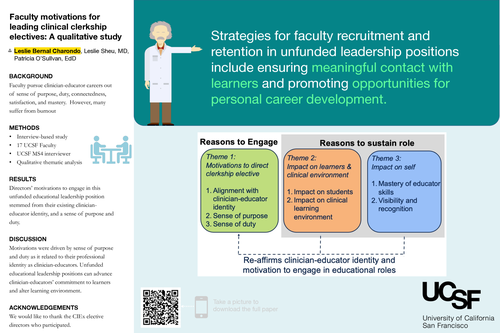
This study explored why faculty volunteer for and are sustained as clerkship elective directors.
Background
Faculty are motivated to pursue clinician-educator careers out of a sense of purpose, duty, connectedness, satisfaction, and mastery.1-3 Yet, many suffer from burnout due to lack of funding, resources, and competing clinical demands. 1-3 Reasons for clinician-educator participation in unfunded educational leadership positions is underexplored. Understanding faculty motivations and experiences in unfunded positions can provide insight into best practices when soliciting faculty engagement in voluntary educational leadership activities.
Methods
In this qualitative study, authors conducted 17 semi-structured interviews with clerkship elective directors in March 2021. Questions focused on factors that engage and sustain them in unfunded leadership positions. Authors conducted a thematic analysis of deidentified transcripts using motivation theories as a lens.
Results
Directors’ motivations to engage in this unfunded educational leadership position stemmed from their existing clinician-educator identity, and a sense of purpose and duty. Directors are sustained by the satisfaction derived from witnessing the positive impact they have on learners’ career development and skills building, the impact of learners on the clinical environment, as well as personal benefits in mastery of educator skills and enhanced visibility as educators.
Discussion
Unfunded educational leadership positions can advance clinician-educators’ commitment to learners and alter the learning environment. Strategies for faculty recruitment and retention in unfunded leadership positions include ensuring meaningful contact with learners, as well as opportunities for personal career development through skills building and enhanced visibility through recognition.
References.
1. Ephgrave K, Margo KL, White C, et al. Core clerkship directors: their current resources and the rewards of the role. Acad Med. 2010;85(4):710-715.
2. Carter JL, Ali II, Isaacson RS, et al. Status of neurology medical school education: Results of 2005 and 2012 clerkship director survey. Neurology. 2014;83(19):1761-1766.
3. Browne J, Webb K, Bullock A. Making the leap to medical education: a qualitative study of medical educators’ experiences. Med Educ. 2018;52(2):216-226.