145 posters, 12 topics, 25 sessions, 145 authors
ePostersLive by SciGen Technologies S.A. All rights reserved.
UCSF 2023 Inquiry Symposium
10 May | University of San Francisco

P102
Multicenter study of long-term outcomes and quality of life in PHACE syndrome
Poster Presenter
Authors
Part of Topic
Clinical & Translational
Introduction:
The term PHACE syndrome was first suggested in 1996 to describe the association between Posterior fossa abnormalities, facial Hemangiomas, Arterial anomalies, Cardiac anomalies, and Eye anomalies (Online Mendelian Inheritance in Man [OMIM] 606519). Since its establishment, research has characterized the condition and established diagnostic criteria, but few studies have investigated the condition’s long-term outcomes leaving patients, families, and clinicians with many unanswered questions.
Aims:
To characterize long term outcomes of PHACE Syndrome in adolescence and adulthood among individuals with definite PHACE ≥10 years of age.
Methods:
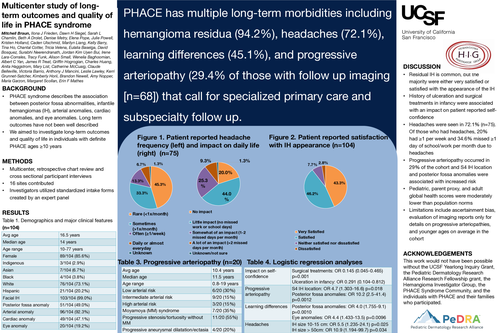
This was a multicenter study with cross-sectional interviews and chart review. Investigators utilized standardized intake forms for data collection. A total of 104/153 (68%) individuals contacted for the study participated in interviews. Data from charts were collected across multiple topics (Hemangiomas, Posterior Fossa/Structural Brain Anomalies, Arterial Anomalies, Neurologic Manifestations, Cardiac Anomalies, Eye Anomalies/Vision, Endocrine, Hearing, Dental, and Social/Emotional). When data were not available in charts, patients were asked directly. Likert scales were used to assess the impact of specific findings including hemangioma residua and headaches. PROMIS quality of life forms were used to assess global health, anxiety, depression, peer relationships, and ability to participate in social roles.
Results:
There was a high rate of infantile hemangioma (IH) residua at 94.1% of the cohort. 89.5% of participants were satisfied or very satisfied with the appearance of the residual IH changes at the time of the interview. Neurologic manifestations were common including headaches/migraines (72.1%), participant reported learning differences (45.1%), and need for educational support (39.4%). Progressive arteriopathies were identified in 20 participants out of a total of 68 with follow up imaging (29.4%). Pediatric, parent proxy, and adult global health scores were moderately lower than population norms, but average scores across other forms otherwise did not differ.
Conclusion:
We report the largest cohort of adolescence and adults with PHACE syndrome. Results confirm the morbidities of PHACE that have been established previously including IH residua, headaches, learning differences, and progressive arteriopathy, among others. There was a large range in severity of these findings from mild to severe. The information this study provides on long-term outcomes argues for long-term primary and specialty follow up care for individuals with PHACE.