145 posters, 12 topics, 25 sessions, 145 authors
ePostersLive by SciGen Technologies S.A. All rights reserved.
UCSF 2023 Inquiry Symposium
10 May | University of San Francisco

P101
Cerebral Spinal Fluid Findings in Rapidly Progressive Dementia
Poster Presenter
Authors
Part of Topic
Clinical & Translational
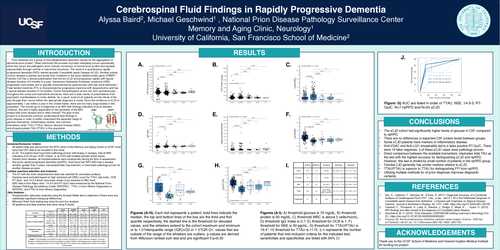
Introduction: Rapidly progressive dementia (RPD) is a concerning disease with many possible etiologies. It is important to accurately diagnose this population as some causes of RPD like infectious or autoimmune encephalitis can be treated while prion diseases are fatal and without available treatment. Approximately 80-95% of all prion diseases are sporadic Creutzfeldt-Jakob disease (sCJD), the remaining percentage is made up primarily from genetic prion disease. MRI with diffusion weighted imaging has high diagnostic accuracy for sCJD, however this test is highly dependent on the experience of the MRI analyst with prion disease which is exceedingly rare. Improved understanding of cerebrospinal fluid findings in patients with RPD will improve diagnosis in the early stages of disease. Aims: • Compare genetic prion disease and sCJD to non-prion RPD (npRPD) cases to determine if there are distinguishing features in the cerebrospinal fluid (CSF) chemistries and inflammatory markers. • Analyze the value and limitations of available CSF biomarkers in the RPD cohort. • Determine which tests are of optimal value when diagnosing an RPD patient. Methods: Retrospective cohort study of patients with rapidly progressive dementia that were evaluated in person or virtually through chart review at the UCSF Memory and Aging Center. Sporadic CJD cases were included if they were pathology proven with evidence of pathogenic prion on brain biopsy or autopsy, met UCSF criteria for an MRI indicative of sCJD, or had an EEG with periodic sharp waves. Non-prion RPD cases were included if an alternative cause of RPD was identified, disease duration was greater than 3 years, or there was clinical improvement. Genetic prion disease cases were included if they were symptomatic at the time of evaluation. Kruskal-Wallis Test with post-hoc Wilcoxon-Rank Sum Test was used to determine if there were statistical differences between groups. Receiver operating characteristic curves were used to compare efficacy of biomarkers. All statistical analysis was performed in R-studio. Results: The cohort consists of patients with sCJD (n = 591), npRPD (n = 271), familial CJD (fCJD, n = 42), Gerstmann-Sträussler-Scheinker syndrome (GSS, n = 22), and Fatal Familial Insomnia (FFI, n = 4) who had documented CSF data. Age of onset for sCJD, npRPD, fCJD, GSS, and FFI respectively (median (IQR): 62.0 (12), 58.0 (14), 50.5 (14), 46.0 (13), 52.0 (5)). There are no significant differences in CSF total protein between groups. CSF glucose of the sCJD cohort is higher than npRPD (median (IQR): 66.0 (12), 63.0 (13), KW: 0.017, p: 0.0016). The CSF white blood cell count was elevated in npRPD relative to sCJD and fCJD (mean ± sd: , 8.8 ± 30.4, 1.9 ± 4.1, 1.5 ± 2.4, KW: 0.021, p-values <0.01). In the sCJD cohort 4.6% had leukocytosis. IgG index in npRPD was elevated relative to sCJD (mean ± sd: 0.6 ± 0.4, 0.5 ± 0.3, KW= 5.3 x 10⁻⁵, p: 3.1 x 10⁻⁶). Oligoclonal band number is significantly elevated in npRPD relative to sCJD (mean ± sd: 0.8 ±1.7, 0.2 ± 0.5, KW: 0.0088, p-value: 0.0014). Total Tau is significantly higher in sCJD, fCJD, and GSS relative to npRPD (4825.1 ± 3825.4, 2221.4 ± 2191.4, 1346.6 ± 1347.8, KW: 2.2 x10⁻¹⁶, p-values: 2.2 x10⁻¹⁶, 0.0068, 0.017). Neuron Specific Enolase is significantly higher in sCJD and fCJD relative to npRPD (mean ± sd: 62.3 ± 49.9, 35.4 ± 38.1, KW: 2.2 x 10⁻¹⁶, p-values: 2.2 x 10⁻¹⁶, 0.032). Total Tau over phosphorylated Tau is elevated in sCJD and GSS relative to npRPD (mean ± sd: 71.3 ± 82.2, 19.2 ± 9.2, 13.6 ± 29.0, KW: 2.8 x 10⁻¹⁰, p-values: 5.7 x 10⁻¹², 0.039). Receiver operating Characteristic analysis comparing utility of RT-QuIC, 14-3-3, NSE, and TTAU in distinguishing sCJD (n=55) from npRPD (n=7) showed that TTAU has the highest AUC 97.4 (95% CI: 93.0, 100.0). Discussion: Prion disease is classically thought to have a normal CSF panel. While there were no differences detected in total protein, it is possible that patients with sCJD are more likely to have elevated CSF glucose levels. This finding may be indicative of an intrinsic reaction to prion but is more likely reflective of a higher proportion of diabetic patients in the sCJD cohort. Further studies would need to be done to determine if diabetes is a risk factor for sCJD. Inflammatory studies including white blood cell count, IgG index, and oligoclonal band number are all more likely to be elevated in npRPD relative to prion diseases. It is important to note however that approximately 5% of the sCJD population has evidence of inflammatory disease. Therefore, the presence of inflammation in the CSF should not rule out a diagnosis of prion disease if there are other factors concerning for the disease. While RT-QuIC is a highly specific test it is not highly sensitive for sCJD. Total tau should be used as screening tool to determine a patient’s likelihood of having prion disease. Ultimately each diagnostic approach has its limitations, and it is important to consider using multiple modalities when diagnosing prion disease. These results are limited by the heterogeneity of laboratory sites and MRI reports, downstream statistical studies will be performed to determine the impact of these variables prior to publication.