145 posters, 12 topics, 25 sessions, 145 authors
ePostersLive by SciGen Technologies S.A. All rights reserved.
UCSF 2023 Inquiry Symposium
10 May | University of San Francisco

P099
Outcomes of Physical Therapy in the Treatment of Shoulder Osteoarthritis
Poster Presenter
Authors
Part of Topic
Clinical & Translational
Introduction: For shoulder osteoarthritis (OA), the understanding of the patient-specific factors that determine the success of both of physical therapy (PT)-based non-operative treatment options is limited. This study aims to identify key factors associated with the response and the heterogeneity of outcomes of PT in the non-operative management of shoulder OA.
Methods: Patients diagnosed with shoulder OA and treated with non-operative management (PT, injections, analgesics, etc.) were enrolled into this single-center study. They were surveyed at enrollment, as well as 3 months and 6 months after enrollment, to ascertain demographic information, phenotypic traits, treatment satisfaction, and patient-reported outcomes (PROs). The minimum clinically important difference (MCID) for the American Shoulder and Elbow Surgeons Score (ASES) of 13.5 and the visual analog scale (VAS) for pain of 1.4 were defined based on the existing literature for shoulder arthroplasty. Patients were split into groups of PT (experimental group) and no PT (control group). Chi-square and T-tests were used compare categorical and continuous variables between the two groups.
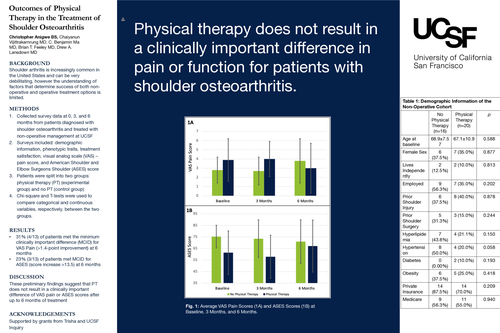
Results: 36 patients were enrolled (13 female, 36.1%) with a mean age of 67.9±9.5 years. There were 20 patients (55.6%) who elected to start physical therapy. There were no differences in demographics between patients who did and did not start physical therapy. Mean initial VAS Pain scores and ASES scores were not significantly different between patients who did and did not start physical therapy (Figure 1). At 3 months and 6 months, patients undergoing physical therapy showed no significant improvement in VAS Pain or ASES scores. Overall, 4 patients (30.8%) met MCID for VAS Pain and 3 patients (23.1%) met MCID for ASES at 6 months with no difference between those with or without physical therapy treatment.
Conclusion: In this single-center study, 56% of non-operative patients elect to try PT for their shoulder OA. These preliminary findings suggest that PT does not result in a clinically important difference of VAS pain or PRO scores after up to 6 months of treatment.