334 posters, 125 sessions, 831 authors, 236 institutions
ePostersLive by SciGen Technologies S.A. All rights reserved.
78th Annual PostGraduate Assembly in Anesthesiology (PGA78) 2024
December 6 - 9, 2024 | New York City

3128
Perioperative Management Considerations for Emergent C-section in Morbidly Obese Parturient with Severe HELLP Syndrome and Neuraxial Contraindication
Poster Presenter
Authors
Affiliations
Part of Topic
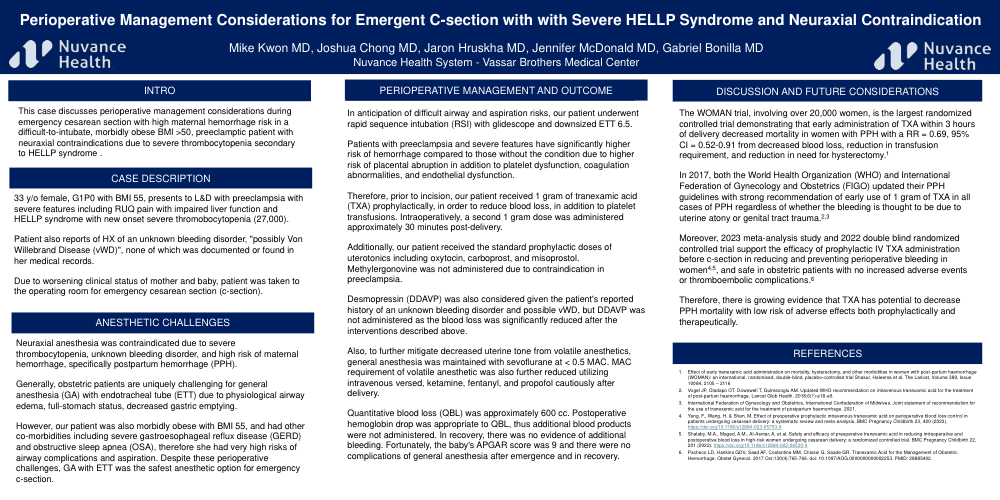
Perioperative Management Considerations for Emergent C-section with with Severe HELLP Syndrome and Neuraxial Contraindication
Mike Kwon MD, Joshua Chong MD, Jaron Hruskha MD, Jennifer McDonald MD, Gabriel Bonilla MD
Nuvance Health System - Vassar Brothers Medical Center
INTRODUCTION
This case discusses perioperative management considerations during emergency cesarean section with high maternal hemorrhage risk in a difficult-to-intubate, morbidly obese BMI >50, preeclamptic patient with neuraxial contraindications due to severe thrombocytopenia secondary to HELLP syndrome .
CASE DESCRIPTION
33 y/o female, G1P0 with BMI 55, presents to L&D with preeclampsia with severe features including RUQ pain with impaired liver function and HELLP syndrome with new onset severe thromobocytopenia (27,000).
Patient also reports of HX of an unknown bleeding disorder, "possibly Von Willebrand Disease (vWD)", none of which was documented or found in her medical records.
Due to worsening clinical status of mother and baby, patient was taken to the operating room for emergency cesarean section (c-section).
ANESTHETIC CHALLENGES
Neuraxial anesthesia was contraindicated due to severe thrombocytopenia, unknown bleeding disorder, and high risk of maternal hemorrhage, specifically postpartum hemorrhage (PPH).
Generally, obstetric patients are uniquely challenging for general anesthesia (GA) with endotracheal tube (ETT) due to physiological airway edema, full-stomach status, decreased gastric emptying.
However, our patient was also morbidly obese with BMI 55, and had other co-morbidities including severe gastroesophageal reflux disease (GERD) and obstructive sleep apnea (OSA), therefore she had very high risks of airway complications and aspiration. Despite these perioperative challenges, GA with ETT was the safest anesthetic option for emergency c-section.
PERIOPERATIVE MANAGEMENT AND OUTCOME
In anticipation of difficult airway and aspiration risks, our patient underwent rapid sequence intubation (RSI) with glidescope and downsized ETT 6.5.
Patients with preeclampsia and severe features have significantly higher risk of hemorrhage compared to those without the condition due to higher risk of placental abruption in addition to platelet dysfunction, coagulation abnormalities, and endothelial dysfunction.
Therefore, prior to incision, our patient received 1 gram of tranexamic acid (TXA) prophylactically, in order to reduce blood loss, in addition to platelet transfusions. Intraoperatively, a second 1 gram dose was administered approximately 30 minutes post-delivery.
Additionally, our patient received the standard prophylactic doses of uterotonics including oxytocin, carboprost, and misoprostol. Methylergonovine was not administered due to contraindication in preeclampsia.
Desmopressin (DDAVP) was also considered given the patient's reported history of an unknown bleeding disorder and possible vWD, but DDAVP was not administered as the blood loss was significantly reduced after the interventions described above.
Also, to further mitigate decreased uterine tone from volatile anesthetics, general anesthesia was maintained with sevoflurane at < 0.5 MAC. MAC requirement of volatile anesthetic was also further reduced utilizing intravenous versed, ketamine, fentanyl, and propofol cautiously after delivery.
Quantitative blood loss (QBL) was approximately 600 cc. Postoperative hemoglobin drop was appropriate to QBL, thus additional blood products were not administered. In recovery, there was no evidence of additional bleeding. Fortunately, the baby's APGAR score was 9 and there were no complications of general anesthesia after emergence and in recovery.
DISCUSSION AND FUTURE CONSIDERATION
The WOMAN trial, involving over 20,000 women, is the largest randomized controlled trial demonstrating that early administration of TXA within 3 hours of delivery decreased mortality in women with PPH with a RR = 0.69, 95% CI = 0.52-0.91 from decreased blood loss, reduction in transfusion requirement, and reduction in need for hysterectomy.1
In 2017, both the World Health Organization (WHO) and International Federation of Gynecology and Obstetrics (FIGO) updated their PPH guidelines with strong recommendation of early use of 1 gram of TXA in all cases of PPH regardless of whether the bleeding is thought to be due to uterine atony or genital tract trauma.2,3
Moreover, 2023 meta-analysis study and 2022 double blind randomized controlled trial support the efficacy of prophylactic IV TXA administration before c-section in reducing and preventing perioperative bleeding in women4,5, and safe in obstetric patients with no increased adverse events or thromboembolic complications.6
Therefore, there is growing evidence that TXA has potential to decrease PPH mortality with low risk of adverse effects both prophylactically and therapeutically.
REFERENCES
-
Effect of early tranexamic acid administration on mortality, hysterectomy, and other morbidities in women with post-partum haemorrhage (WOMAN): an international, randomised, double-blind, placebo-controlled trial Shakur, Haleema et al. The Lancet, Volume 389, Issue 10084, 2105 – 2116
-
Vogel JP, Oladapo OT, Dowswell T, Gulmezoglu AM. Updated WHO recommendation on intravenous tranexamic acid for the treatment of post-partum haemorrhage. Lancet Glob Health. 2018;6(1):e18-e9.
-
International Federation of Gynecology and Obstetrics, International Confederation of Midwives. Joint statement of recommendation for the use of tranexamic acid for the treatment of postpartum haemorrhage. 2021.
-
Yang, F., Wang, H. & Shen, M. Effect of preoperative prophylactic intravenous tranexamic acid on perioperative blood loss control in patients undergoing cesarean delivery: a systematic review and meta-analysis. BMC Pregnancy Childbirth 23, 420 (2023). https://doi.org/10.1186/s12884-023-05753-9
-
Shalaby, M.A., Maged, A.M., Al-Asmar, A. et al. Safety and efficacy of preoperative tranexamic acid in reducing intraoperative and postoperative blood loss in high-risk women undergoing cesarean delivery: a randomized controlled trial. BMC Pregnancy Childbirth 22, 201 (2022). https://doi.org/10.1186/s12884-022-04530-4
-
Pacheco LD, Hankins GDV, Saad AF, Costantine MM, Chiossi G, Saade GR. Tranexamic Acid for the Management of Obstetric Hemorrhage. Obstet Gynecol. 2017 Oct;130(4):765-769. doi: 10.1097/AOG.0000000000002253. PMID: 28885402.