334 posters, 125 sessions, 831 authors, 236 institutions
ePostersLive by SciGen Technologies S.A. All rights reserved.
78th Annual PostGraduate Assembly in Anesthesiology (PGA78) 2024
December 6 - 9, 2024 | New York City

3012
Blown-up pupil after intranasal phenylephrine administration – don’t be surprised, it’s common
Poster Presenter
Authors
Affiliations
Part of Topic
| Blown-up pupil after intranasal phenylephrine administration – don’t be surprised, it’s common | |
| Assess the physiologic effects of a commonly-used intraoperative medication in order to recognize and anticipate lesser-known consequences of its use. | |
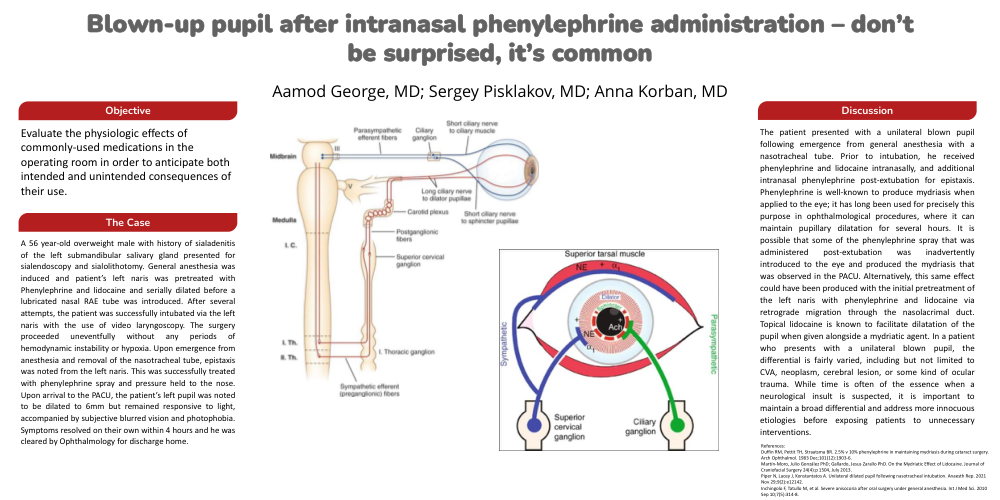
| A 56 year-old obese male with history of sialadenitis of the left submandibular salivary gland presented for sialendoscopy and sialolithotomy. General anesthesia was induced and patient’s left naris was pretreated with Phenylephrine and lidocaine and serially dilated before a lubricated nasal RAE tube was introduced. After several attempts, the patient was successfully intubated via the left naris with the use of video laryngoscopy. The surgery proceeded uneventfully without any periods of hemodynamic instability or hypoxia. Upon emergence from anesthesia and removal of the nasotracheal tube, epistaxis was noted from the left naris. This was successfully treated with phenylephrine spray and pressure held to the nose. Upon arrival to the PACU, the patient’s left pupil was noted to be dilated to 6mm but remained responsive to light, accompanied by subjective blurred vision and photophobia. Symptoms resolved on their own within 4 hours and he was cleared by Ophthalmology for disch arge home. | |
| The patient presented with a unilateral blown pupil following emergence from general anesthesia with a nasotracheal tube. Prior to intubation, he received phenylephrine and lidocaine intranasally, and additional intranasal phenylephrine post-extubation for epistaxis. Phenylephrine is well-known to produce mydriasis when applied to the eye; it has long been used for precisely this purpose in ophthalmological procedures, where it can maintain pupillary dilatation for several hours. It is possible that some of the phenylephrine spray that was administered post-extubation was inadvertently introduced to the eye and produced the mydriasis that was observed in the PACU. Alternatively, this same effect could have been produced with the initial pretreatment of the left naris with phenylephrine and lidocaine via retrograde migration through the nasolacrimal duct. Topical lidocaine is known to facilitate dilatation of the pupil when given alongside a mydriatic agent. In a patient who presents with a unilateral blown pupil, the differential is fairly varied, including but not limited to CVA, neoplasm, cerebral lesion, or some kind of ocular trauma. While time is often of the essence when a neurological insult is suspected, it is important to maintain a broad differential and address more innocuous etiologies before exposing patients to unnecessary interventions. | |
| Duffin RM, Pettit TH, Straatsma BR. 2.5% v 10% phenylephrine in maintaining mydriasis during cataract surgery. Arch Ophthalmol. 1983 Dec;101(12):1903-6. doi: 10.1001/archopht.1983.01040020905014. PMID: 6651596. Martín-Moro, Julio González PhD; Gallardo, Jesus Zarallo PhD. On the Mydriatic Effect of Lidocaine. Journal of Craniofacial Surgery 24(4):p 1504, July 2013. | DOI: 10.1097/SCS.0b013e3182902d63 Piper N, Lacey J, Konstantatos A. Unilateral dilated pupil following nasotracheal intubation. Anaesth Rep. 2021 Nov 29;9(2):e12142. doi: 10.1002/anr3.12142. PMID: 34881365; PMCID: PMC8629712. Inchingolo F, Tatullo M, Abenavoli FM, Marrelli M, Inchingolo AD, Villabruna B, Inchingolo AM, Dipalma G. Severe anisocoria after oral surgery under general anesthesia. Int J Med Sci. 2010 Sep 10;7(5):314-8. doi: 10.7150/ijms.7.314. PMID: 20922052; PMCID: PMC2948214. |