334 posters, 125 sessions, 831 authors, 236 institutions
ePostersLive by SciGen Technologies S.A. All rights reserved.
78th Annual PostGraduate Assembly in Anesthesiology (PGA78) 2024
December 6 - 9, 2024 | New York City

3013
Use of a Low-Flow Nasal Mask-Face Tent for Immediate Pressure-Controlled Ventilation/Oxygenation and Reduced Droplet/Aerosol Spread in an Obese OSA Patient during TEE
Poster Presenter
Part of Topic
A Simple Low-Flow Nasal Mask-Face Tent Provided Immediate Pressure-Controlled Ventilation/Oxygenation and Reduced Aerosol/Droplet Spread in an Obese Patient with OSA during Outpatient TEE under MAC at NORA
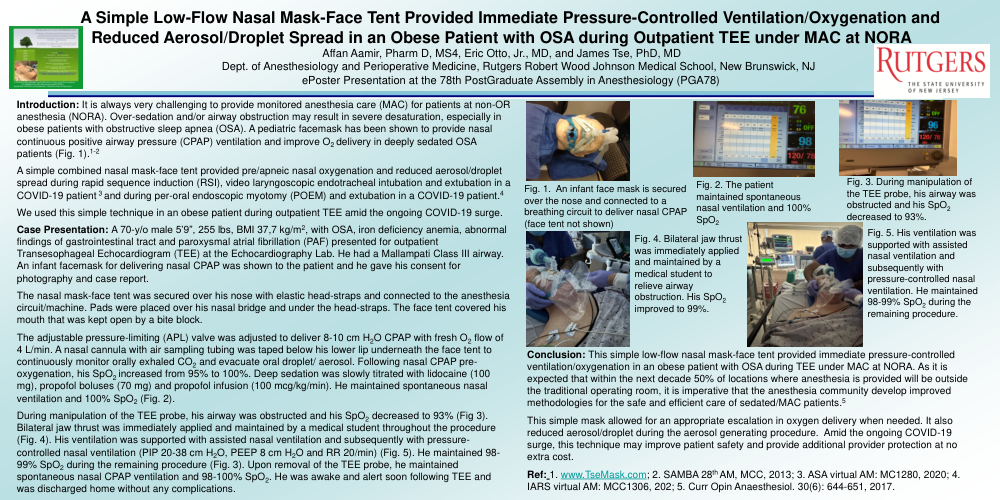
Introduction: It is always very challenging to provide monitored anesthesia care (MAC) for patients at non-OR anesthesia (NORA). Over-sedation and/or airway obstruction may result in severe desaturation, especially in obese patients with obstructive sleep apnea (OSA). A pediatric facemask has been shown to provide nasal continuous positive airway pressure (CPAP) ventilation and improve O2 delivery in deeply sedated OSA patients (Fig. 1).1-2 A simple combined nasal mask-face tent provided pre/apneic nasal oxygenation and reduced aerosol/droplet spread during rapid sequence induction (RSI), video laryngoscopic endotracheal intubation and extubation in a COVID-19 patient 3 and during per-oral endoscopic myotomy (POEM) and extubation in a COVID-19 patient.4 We used this simple technique in an obese patient during outpatient TEE amid the ongoing COVID-19 surge.
Case Presentation:
A 70-y/o male 5’9”, 255 lbs, BMI 37,7 kg/m2, with OSA, iron deficiency anemia, abnormal findings of gastrointestinal tract and paroxysmal atrial fibrillation (PAF) presented for outpatient Transesophageal Echocardiogram (TEE) at the Echocardiography Lab. He had a Mallampati Class III airway. An infant facemask for delivering nasal CPAP was shown to the patient and he gave his consent for photography and case report.
The nasal mask-face tent was secured over his nose with elastic head-straps and connected to the anesthesia circuit/machine. Pads were placed over his nasal bridge and under the head-straps. The face tent covered his mouth that was kept open by a bite block.
The adjustable pressure-limiting (APL) valve was adjusted to deliver 8-10 cm H2O CPAP with fresh O2 flow of 4 L/min. A nasal cannula with air sampling tubing was taped below his lower lip underneath the face tent to continuously monitor orally exhaled CO2 and evacuate oral droplet/ aerosol. Following nasal CPAP pre-oxygenation, his SpO2 increased from 95% to 100%. Deep sedation was slowly titrated with lidocaine (100 mg), propofol boluses (70 mg) and propofol infusion (100 mcg/kg/min). He maintained spontaneous nasal ventilation and 100% SpO2 (Fig. 2).
During manipulation of the TEE probe, his airway was obstructed and his SpO2 decreased to 93% (Fig 3). Bilateral jaw thrust was immediately applied and maintained by a medical student throughout the procedure (Fig. 4). His ventilation was supported with assisted nasal ventilation and subsequently with pressure-controlled nasal ventilation (PIP 20-38 cm H2O, PEEP 8 cm H2O and RR 20/min) (Fig. 5). He maintained 98-99% SpO2 during the remaining procedure (Fig. 3). Upon removal of the TEE probe, he maintained spontaneous nasal CPAP ventilation and 98-100% SpO2. He was awake and alert soon following TEE and was discharged home without any complications.
Conclusion: This simple low-flow nasal mask-face tent provided immediate pressure-controlled ventilation/oxygenation in an obese patient with OSA during TEE under MAC at NORA. As it is expected that within the next decade 50% of locations where anesthesia is provided will be outside the traditional operating room, it is imperative that the anesthesia community develop improved methodologies for the safe and efficient care of sedated/MAC patients.5 This simple mask allowed for an appropriate escalation in oxygen delivery when needed. It also reduced aerosol/droplet during the aerosol generating procedure.
Amid the ongoing COVID-19 surge, this technique may improve patient safety and provide additional provider protection at no extra cost.
References: 1. www.tsemask.com; 2. SAMBA 28th AM, MCC, 2013; 3. ASA virtual AM: MC1280, 2020; 4. IARS virtual AM: MCC1306, 202; 5. Curr Opin Anaesthesiol. 30(6): 644-651, 2017.