334 posters, 125 sessions, 831 authors, 236 institutions
ePostersLive by SciGen Technologies S.A. All rights reserved.
78th Annual PostGraduate Assembly in Anesthesiology (PGA78) 2024
December 6 - 9, 2024 | New York City

3008
Anesthetic Management of a Parturient with Congenital Long QT Syndrome
Poster Presenter
Part of Topic
Learning Objective:
- Identify a multidisciplinary approach to patient care with obstetrics, maternal fetal medicine, and obstetric anesthesiology to optimize parturients with congenital long QT syndrome for safe delivery and peripartum care.
- Review common complications associated with congenital long QT syndrome in pregnancy
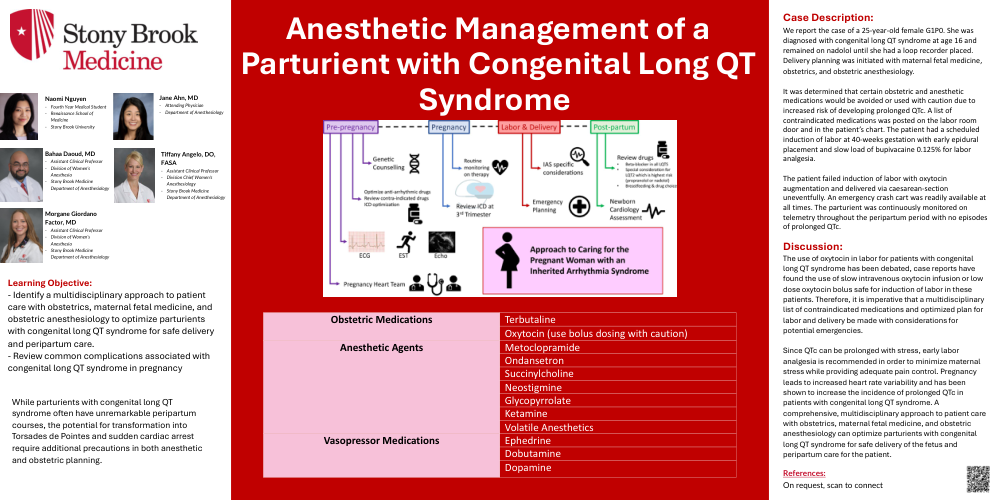
While parturients with congenital long QT syndrome often have unremarkable peripartum courses, the potential for transformation into Torsades de Pointes and sudden cardiac arrest require additional precautions in both anesthetic and obstetric planning.
Case Description:
We report the case of a 25-year-old female G1P0. She was diagnosed with congenital long QT syndrome at age 16 and remained on nadolol until she had a loop recorder placed. Delivery planning was initiated with maternal fetal medicine, obstetrics, and obstetric anesthesiology.
It was determined that certain obstetric and anesthetic medications would be avoided or used with caution due to increased risk of developing prolonged QTc. A list of contraindicated medications was posted on the labor room door and in the patient’s chart. The patient had a scheduled induction of labor at 40-weeks gestation with early epidural placement and slow load of bupivacaine 0.125% for labor analgesia.
The patient failed induction of labor with oxytocin augmentation and delivered via caesarean-section uneventfully. An emergency crash cart was readily available at all times. The parturient was continuously monitored on telemetry throughout the peripartum period with no episodes of prolonged QTc.
Discussion:
The use of oxytocin in labor for patients with congenital long QT syndrome has been debated, case reports have found the use of slow intravenous oxytocin infusion or low dose oxytocin bolus safe for induction of labor in these patients. Therefore, it is imperative that a multidisciplinary list of contraindicated medications and optimized plan for labor and delivery be made with considerations for potential emergencies.
Since QTc can be prolonged with stress, early labor analgesia is recommended in order to minimize maternal stress while providing adequate pain control. Pregnancy leads to increased heart rate variability and has been shown to increase the incidence of prolonged QTc in patients with congenital long QT syndrome. A comprehensive, multidisciplinary approach to patient care with obstetrics, maternal fetal medicine, and obstetric anesthesiology can optimize parturients with congenital long QT syndrome for safe delivery of the fetus and peripartum care for the patient.